Case Study
Vehicle-as-a-Service strategy for truck ecosystems
Prioritising VaaS opportunities across electrification, charging and fleet digital services.


Prioritising VaaS opportunities across electrification, charging and fleet digital services.
CamIn works with early adopters to identify new opportunities enabled by emerging technology.
of CamIn’s project team comprised of leading industry and technology experts


CamIn identified 15+ high-value Vehicle-as-a-Service opportunities, refined into 5 priority initiatives, enabling the client to define a scalable strategy across electrification, charging, and digital fleet services while de-risking a €10 million investment.
Venture Pathfinder
The client had made strong progress in electrification and digital foundations but lacked a clear commercial strategy to monetise these capabilities through new service models.
They aimed to identify viable Vehicle-as-a-Service opportunities across hardware, software, and digital layers.
The engagement focused on prioritising near-term and mid-term innovations, while systematically de-risking technology and business model choices to avoid fragmented investments and ensure scalable, defensible growth bets aligned with long-term market direction.

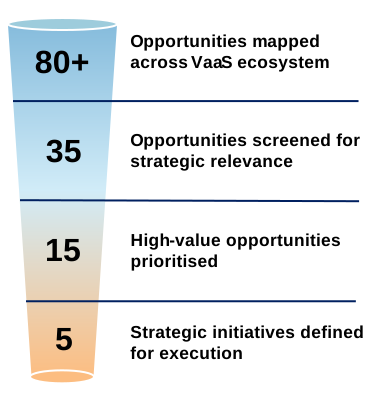
80+ | Opportunities identified across the Vaas ecosystem covering hardware, software, and digital services including charging, battery lifecycle, and fleet data monetisation models. |
35 | Opportunities screened based on strategic fit, customer demand, and technical feasibility to align with the client’s electrification and digital roadmap. |
15 | High-value opportunities prioritised through detailed assessment of commercial viability, scalability, and recurring revenue potential across the value chain. |
5 | Strategic initiatives defined with clear execution pathways including charging-as-a-service, battery solutions, and digital fleet platforms. |

CamIn defined a prioritised Vaas opportunity portfolio across hardware, software, and digital services, identifying high-value quick wins and longer-term growth plays.
The client is now progressing pilot programs in charging, battery leasing, and uptime-based services, with internal teams aligned to execution roadmaps.
The work identified potential multi-billion-euro revenue upside.
Download our detailed case study to learn more about how CamIn and our hand-selected expert project team delivered these results for our client.

.svg)
Vehicle-as-a-Service (Vaas) refers to the shift from one-time vehicle sales towards recurring, service-based revenue models across the vehicle lifecycle. In the commercial vehicle sector, this includes bundled offerings such as charging, battery leasing, uptime guarantees, fleet optimisation software, and data-driven services.
Rather than selling hardware alone, manufacturers and ecosystem players monetise usage, performance, and operational outcomes. This model integrates physical assets with digital platforms, creating continuous customer engagement and predictable revenue streams tied to fleet operations and total cost of ownership.
The transition to electrified and connected fleets is structurally changing how value is created and captured. Hardware margins are under pressure due to competition, regulation, and capital intensity. At the same time, customers increasingly prioritise predictable operating costs, uptime, and integrated solutions over asset ownership.
Vaas enables manufacturers to capture value beyond the initial sale by embedding themselves deeper into customer operations. This creates recurring revenue streams, improves customer retention, and strengthens competitive differentiation.
It also helps de-risk large capital investments in electrification by aligning revenue with usage. Instead of relying solely on vehicle sales volumes, companies can monetise infrastructure, software, and services over time. This is particularly relevant as fleets face uncertainty around charging infrastructure, battery performance, and regulatory changes.
The opportunity space for Vaas is broad, but value creation is uneven. The most attractive areas combine near-term feasibility with scalable revenue models.
Charging remains one of the most immediate bottlenecks for fleet electrification, creating strong demand for integrated solutions.
Quick wins include depot charging-as-a-service, where providers design, install, and operate charging infrastructure with predictable monthly fees. This reduces upfront capital requirements for fleet operators and accelerates adoption.
Mid-term opportunities lie in energy optimisation services, including load balancing, smart charging, and integration with renewable energy sources. These services can reduce energy costs by 10 to 20 percent and create new revenue streams through grid participation.
Long-term value will be driven by energy platform models, where providers orchestrate charging across multiple fleets and locations. This enables participation in energy markets, demand response programmes, and virtual power plant ecosystems. Companies that secure early positions in this layer can capture a disproportionate share of value.
Battery cost and performance remain central to the economics of electric fleets. This creates a strong case for service-based models that shift risk away from customers.
Quick wins include battery leasing and performance guarantees, allowing fleet operators to avoid large upfront costs while ensuring predictable performance. These models also create recurring revenue for providers.
Mid-term opportunities focus on battery analytics and predictive maintenance, using real-time data to extend asset life and reduce downtime. This can improve utilisation rates by 5 to 10 percent, directly impacting fleet economics.
Long-term opportunities include second-life applications and closed-loop recycling. Companies that control battery lifecycle data and infrastructure will be well positioned to capture value across reuse and material recovery markets.
Digital services represent one of the most scalable layers of Vaas, with relatively low marginal costs and strong margin potential.
Quick wins include telematics and basic fleet management tools that improve routing, driver behaviour, and fuel or energy efficiency. These are already widely adopted but remain fragmented.
Mid-term opportunities lie in integrated fleet optimisation platforms that combine vehicle, energy, and operational data. These platforms can reduce total cost of ownership by 5 to 15 percent through improved planning and utilisation.
Long-term value will be driven by autonomous decision-making systems that optimise entire fleet operations in real time. Companies that build proprietary data ecosystems will create strong barriers to entry and long-term customer lock-in.
Fleet operators are increasingly focused on uptime and reliability rather than asset ownership. This creates opportunities for performance-based service models.
Quick wins include service contracts linked to maintenance and uptime guarantees, reducing operational risk for customers.
Mid-term opportunities involve outcome-based pricing, where customers pay based on kilometres driven, availability, or delivered service levels. This aligns incentives between provider and customer.
Long-term models will integrate predictive analytics, remote diagnostics, and automated servicing, enabling near-zero unplanned downtime. Providers that can consistently deliver high uptime will command premium pricing and long-term contracts.
The Vaas model is underpinned by a combination of physical and digital technologies. The competitive advantage lies in how these technologies are integrated and scaled.
Battery technology continues to evolve, with improvements in energy density, charging speed, and lifecycle performance.
Strengths include ongoing cost reductions and improved performance, making electrification more viable for heavy-duty applications. Weaknesses remain around degradation, residual value uncertainty, and supply chain constraints for critical materials.
Opportunities lie in advanced battery management systems that optimise usage and extend lifespan. These systems enable new service models such as performance guarantees and leasing.
Threats include rapid technology shifts that can render existing assets less competitive, as well as dependency on raw material supply chains. Companies that invest in battery data and lifecycle control will have a strategic advantage.
Charging technology is becoming more sophisticated, moving beyond simple hardware deployment towards integrated energy systems.
Strengths include increasing standardisation and improved charging speeds. Weaknesses include high upfront costs and complexity in grid integration, particularly for large depots.
Opportunities lie in software-driven energy management, including smart charging, load optimisation, and integration with renewable energy. These capabilities can significantly reduce operating costs and create new revenue streams.
Threats include regulatory uncertainty and dependency on external energy infrastructure. Companies that can offer end-to-end solutions, combining hardware, software, and services, will be better positioned.
Data is a core enabler of Vaas, providing visibility into vehicle performance, usage, and operational efficiency.
Strengths include the ability to generate continuous insights and enable real-time decision-making. Weaknesses include data fragmentation and integration challenges across different systems and stakeholders.
Opportunities lie in building unified data platforms that integrate vehicle, energy, and operational data. These platforms enable advanced analytics, predictive maintenance, and optimisation services.
Threats include cybersecurity risks and increasing competition from software-native players. Companies that can secure and scale proprietary data ecosystems will create long-term differentiation.
Artificial intelligence is increasingly used to optimise fleet operations, energy usage, and maintenance activities.
Strengths include the ability to process large volumes of data and generate actionable insights. Weaknesses include reliance on high-quality data and challenges in model transparency and trust.
Opportunities lie in end-to-end optimisation, where AI systems manage routing, charging, and maintenance in an integrated manner. This can deliver significant cost savings and efficiency gains.
Threats include regulatory scrutiny and the risk of over-reliance on automated systems. Companies that combine AI capabilities with strong domain expertise will be better positioned to capture value.


