Case Study
Autonomous trucking partner ecosystem
Benchmarking autonomous trucking partners to enable scalable and efficient freight operations


Benchmarking autonomous trucking partners to enable scalable and efficient freight operations
CamIn works with early adopters to identify new opportunities enabled by emerging technology.
of CamIn’s project team comprised of leading industry and technology experts


Our transport and logistics client sought to identify and prioritise strategic partners to enable scalable autonomous trucking over the next 5 years. CamIn identified and prioritised a partner ecosystem across 5 capability domains to enable autonomous logistics at scale.
Innovation Bridge
The client aimed to modernise its freight operations through autonomous trucking but lacked a clear partner ecosystem across sensors, software, connectivity and infrastructure.
They required an independent assessment of vendors to support scalable deployment. The engagement focused on identifying and prioritising best-fit partners across the value chain.
Expected impact included reducing operating costs by 10-15 percent, accelerating deployment timelines, and avoiding several million euros in misallocated investment.
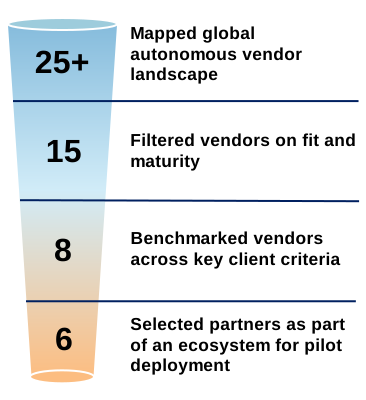
25+ | Mapped a global landscape of vendors across sensing, autonomy software, connectivity and infrastructure relevant to autonomous freight deployment. |
15 | Filtered vendors based on technical maturity, operational fit and alignment with the client’s logistics strategy and deployment roadmap. |
8 | Conducted detailed benchmarking across performance, scalability and integration feasibility to enable objective comparison of shortlisted partners. |
6 | Defined a focused shortlist of priority partners to support pilot programmes and phased autonomous trucking deployment. |

Identified and benchmarked 25 vendors, delivering a focused shortlist across critical capability areas for autonomous logistics.
Client is progressing pilot programmes with selected partners to validate integration and operational performance.
Enabled cost reduction potential of €10 million annually through improved efficiency and reduced driver dependency.
Download our detailed case study to learn more about how CamIn and our hand-selected expert project team delivered these results for our client.

.svg)
Autonomous trucking refers to the deployment of self-driving capabilities in freight transport to reduce reliance on human drivers, improve asset utilisation, and enhance safety. It is enabled by a combination of sensors, AI-driven software, connectivity, mapping, and infrastructure.
As no single provider delivers a complete solution, companies must build structured partner ecosystems across this stack. This involves selecting and integrating specialised vendors to enable scalable, commercially viable autonomous operations.
Transport and logistics operators face structural pressures including driver shortages, rising labour costs, and the need to improve fleet efficiency. Autonomous trucking offers a pathway to reduce operating costs by 10-20 percent over time, while increasing vehicle utilisation and improving delivery predictability.
The complexity of the technology stack introduces integration risk. Poor partner selection can lead to delays, cost overruns, and limited scalability. A well-defined partner ecosystem enables faster deployment, reduces risk exposure, and preserves strategic flexibility as technologies evolve.
Autonomous trucking is shifting from isolated pilots to early commercial deployment, creating a fragmented but increasingly investable opportunity landscape. Value is not evenly distributed across the stack. Some areas already offer near-term efficiency gains, while others require longer-term positioning. Understanding where to prioritise investment is critical to capturing value while avoiding premature commitments.
Autonomous driving software is emerging as the control layer of the trucking ecosystem. Quick-win opportunities are centred on advanced driver assistance and supervised autonomy, where software improves safety and reduces driver fatigue without requiring full autonomy. These deployments can deliver immediate ROI through reduced incident rates and insurance costs.
Mid-term opportunities focus on hub-to-hub autonomous operations, where routes are predictable and infrastructure requirements are manageable. This enables logistics operators to redesign network models by shifting long-haul driving to autonomous systems while retaining human drivers for first and last mile segments. The result is lower labour costs combined with improved fleet utilisation.
Long-term opportunities lie in fully autonomous operations across mixed traffic environments. This unlocks continuous vehicle utilisation and more flexible routing models. However, it remains dependent on regulatory progress and further technical maturity. Early partnerships in software create long-term advantages in integration and data access.
Sensors such as LiDAR, radar, and cameras form the foundation of autonomous perception. In the short term, enhanced safety systems can be integrated into existing fleets, reducing collision rates and unplanned downtime.
Mid-term, sensor fusion systems are becoming more reliable and cost-effective, enabling scalable deployment in controlled environments. This creates an opportunity to standardise hardware across fleets, reducing maintenance complexity and procurement variability.
Long-term, differentiation shifts from hardware to data interpretation. As sensor costs decline, value will be created through how effectively perception data is processed and integrated into decision-making systems. This makes integrated perception platforms more strategically important than standalone hardware providers.
Connectivity enables real-time data exchange, remote monitoring, and fleet optimisation. Immediate opportunities exist in upgrading telematics systems to improve visibility into vehicle performance, routing, and utilisation. This can deliver quick gains in fuel efficiency and maintenance planning.
Mid-term, 5G connectivity supports remote operations and real-time intervention in semi-autonomous environments. This allows operators to centralise control functions and scale operations without proportional increases in personnel.
Long-term, connectivity becomes the backbone of fully autonomous fleet orchestration. Vehicles operate as part of a coordinated system, optimising routing, load balancing, and scheduling. Early investment in scalable connectivity architectures positions operators to capture these efficiencies.
High-definition mapping supports accurate localisation and route planning. In the short term, improved mapping enhances route optimisation and reduces delivery times.
Mid-term opportunities involve dynamic mapping, where real-time updates reflect changing road and traffic conditions. This enables more adaptive routing and reduces operational disruptions.
Long-term, mapping evolves into a shared infrastructure layer across the ecosystem. Control over mapping data becomes strategically important, as it influences routing efficiency and system reliability. Partner selection should therefore consider data ownership and interoperability, not just technical capability.
Autonomous trucking is underpinned by a set of interdependent technologies, each evolving at a different pace. While many have reached advanced levels of maturity, their combined integration remains complex. For operators, the challenge is not only selecting the right technologies, but understanding their trade-offs, scalability, and long-term strategic implications before committing capital.
LiDAR combined with radar and camera systems provides high-resolution environmental perception. Its primary strength is robustness across different driving conditions, improving safety and reliability.
However, LiDAR systems remain relatively expensive and can be sensitive to environmental factors such as adverse weather. This creates cost and performance trade-offs for large-scale deployment.
The opportunity lies in sensor fusion, combining multiple data sources to improve accuracy while reducing reliance on any single technology. The risk is investing too early in hardware before cost reductions materialise, leading to unnecessary capital expenditure.
AI models enable perception, decision-making, and vehicle control. Their strength lies in continuous improvement through data, allowing systems to become more accurate over time.
The limitation is the need for large datasets and extensive validation to ensure safety. This creates high barriers to entry and concentration among a limited number of providers.
The opportunity is to partner with scalable platforms that offer strong data capabilities. The risk is dependency on proprietary systems, which can reduce flexibility and increase long-term costs. Data ownership and integration flexibility are therefore critical considerations.
5G and edge computing enable low-latency communication and real-time data processing, supporting remote monitoring and intervention.
The strength is the ability to scale fleet operations with centralised control. However, coverage limitations remain a constraint, particularly in less densely populated regions.
The opportunity lies in hybrid architectures that combine onboard processing with connectivity. This improves reliability while maintaining scalability. The risk is over-reliance on network infrastructure that may not deliver consistent performance across all routes.
HD mapping enables precise localisation and environmental awareness. Its strength is improved navigation accuracy and reduced uncertainty in vehicle positioning.
The challenge is maintaining up-to-date maps in dynamic environments, which requires continuous data collection and processing.
The opportunity is in dynamic mapping solutions that integrate real-time data inputs. This enhances system resilience and adaptability. The risk is fragmentation across mapping standards, which can limit interoperability. Selecting interoperable solutions is therefore a key strategic consideration.


