Case Study
Strategic roadmap for bio-based textile alternatives
Identifying scalable bio-based materials and partners for long-term product transformation


Identifying scalable bio-based materials and partners for long-term product transformation
CamIn works with early adopters to identify new opportunities enabled by emerging technology.
of CamIn’s project team comprised of leading industry and technology experts


Our global FMCG client sought to identify scalable bio-based material alternatives to secure long-term product competitiveness. CamIn applied a structured innovation funnel to identify high-impact material alternatives and strategic partners for long-term adoption.
Horizon & Portfolio Scanner
The client was operating from a position of strength but faced increasing regulatory, environmental and supply chain pressures linked to conventional textile materials. This created strategic risk across cost base, brand positioning and long-term viability.
They required a structured view of emerging bio-based alternatives, with clarity on which technologies and partners could enable a credible transition over the next two decades.
The ambition was to reduce dependency on unsustainable inputs, strengthen ESG performance and unlock product differentiation, with goal to capture long-term value through cost optimisation and premium positioning.
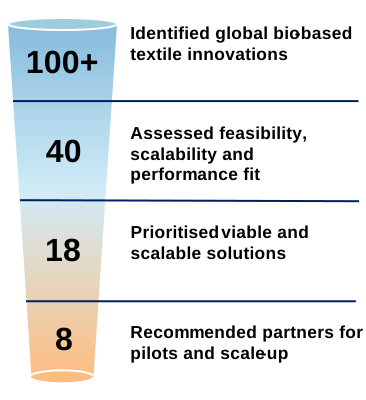
100+ | Identified global bio-based textile innovations across technologies and maturity stages relevant to core material substitution |
40 | Assessed approaches against technical feasibility, scalability and alignment with performance requirements |
18 | Prioritised high-potential solutions based on viability, sustainability and commercial fit to product strategy |
8 | Recommended strategic partners with strongest capability to support pilot execution and long-term adoption |

Delivered a prioritised portfolio of bio-based material pathways, supported by a clear adoption roadmap and partner ecosystem.
The client is progressing targeted pilots and strategic partnerships aligned to its future product pipeline.
Identified over $15 million long-term value potential through material substitution, brand differentiation and ESG-driven growth.
Download our detailed case study to learn more about how CamIn and our hand-selected expert project team delivered these results for our client.

.svg)
Bio-based textile innovation refers to the development of fibres and materials derived from renewable biological sources that can replace conventional inputs such as cotton, wool and petroleum-based synthetics. These include plant-based fibres, regenerated cellulose, bio-fabricated proteins and recycled biological feedstocks designed to deliver comparable or improved performance characteristics.
Why are bio-based textiles important for the sector?
The apparel and footwear sector faces increasing pressure to reduce environmental impact while maintaining product performance and cost competitiveness. Conventional materials are linked to water intensity, carbon emissions and fossil dependency, creating exposure to regulation, supply volatility and shifting consumer expectations.
Bio-based alternatives provide a pathway to reduce environmental footprint while strengthening long-term supply resilience. They also enable brands to differentiate through sustainability credentials, increasingly influencing purchasing decisions and pricing power.
Companies can unlock value through selective material substitution in high-volume product lines, improving margin resilience and reducing exposure to volatile raw material inputs. Early adoption also creates opportunities to shape supply chains, secure preferential partnerships and influence emerging standards.
There is growing potential to develop premium product categories built around sustainability, enabling higher price points and brand differentiation. In parallel, circular material models are opening opportunities to reduce waste, lower lifecycle costs and create new revenue streams linked to recycling and material recovery.
Quick-win opportunities lie in blending bio-based fibres such as lyocell, bamboo viscose and recycled cellulose into existing product lines without compromising performance. These can reduce environmental footprint while maintaining cost parity, particularly in mid-tier products where margins are more flexible.
Mid-term, companies can redesign core fabrics using hybrid compositions that reduce reliance on elastane and petroleum-derived inputs. This is particularly relevant as elastane increasingly limits recyclability and introduces regulatory risk. Early movers are already exploring elastane-free stretch fabrics and bio-based alternatives that can be integrated without major supply chain disruption.
Long-term, the opportunity shifts towards fully bio-fabricated performance materials that replicate or exceed the durability, stretch and moisture management of conventional fibres. This creates potential for proprietary material platforms, enabling both product differentiation and licensing revenue. The strategic advantage will lie in controlling formulations and securing early access to scalable supply.
Quick wins are emerging in substituting conventional cotton with lower-impact alternatives such as organic cotton, hemp blends and regenerated fibres. These shifts can be implemented with minimal redesign and offer immediate ESG improvements, particularly in high-volume product categories.
Mid-term opportunities focus on fibre standardisation and supply chain optimisation. Companies that invest early in supplier partnerships can secure stable access to alternative feedstocks and reduce exposure to cotton price volatility and water-related constraints. There is also an opportunity to reduce processing costs as newer fibres require less chemical treatment.
Long-term, circular material systems present a significant opportunity. Fibre-to-fibre recycling and closed-loop production models could reduce raw material dependency and create cost advantages at scale. Companies that integrate recycling into their operating model may benefit from lower input costs and regulatory incentives, particularly in regions introducing extended producer responsibility frameworks.
In the near term, premium brands can leverage bio-based materials as a differentiation lever, commanding higher price points through sustainability-led storytelling. Materials such as plant-based leathers, alternative fibres from agricultural waste and innovative blends offer immediate brand value even before full cost competitiveness is achieved.
Mid-term, there is an opportunity to develop exclusive partnerships with emerging material innovators. Securing early-stage supply agreements or equity stakes can provide preferential access and limit competitor entry. This is particularly relevant for materials with constrained production capacity in the early years of scale-up.
Long-term, premium segments are likely to act as testing grounds for next-generation materials such as bio-fabricated proteins and engineered fibres. These materials could redefine product categories, enabling entirely new textures, performance characteristics and design possibilities. The strategic upside lies in shaping consumer expectations and setting new benchmarks for sustainability and performance.
Quick wins include replacing conventional textiles in non-critical components such as linings, uppers and insulation materials with bio-based alternatives. These substitutions can be implemented without affecting core product performance and offer immediate sustainability gains.
Mid-term opportunities focus on integrating bio-based materials into structural components, including stretch fabrics and reinforcement layers. This requires deeper material innovation but can significantly reduce reliance on synthetic polymers and improve recyclability.
Long-term, fully circular footwear systems represent a major opportunity. Designing products for disassembly and material recovery could reduce waste and create secondary revenue streams through material reuse. Companies that align product design with recycling infrastructure will be better positioned to capture value as circularity becomes a regulatory and commercial requirement.
Advances in regenerated cellulose fibres such as lyocell and next-generation wood-based materials are improving performance while reducing environmental impact. Bio-fabricated fibres, including synthetic proteins and engineered spider silk, are progressing towards commercial viability for high-performance applications.
Recycling technologies are also evolving, including enzymatic and chemical processes that enable fibre-to-fibre recovery and reduce reliance on virgin inputs. In parallel, innovations in natural fibres such as hemp, bamboo and agricultural residues are being refined to meet durability and comfort requirements at scale.
Regenerated fibres such as lyocell and modal are among the most commercially mature bio-based alternatives. Their strength lies in scalability, established supply chains and relatively low environmental impact compared to conventional cotton. They also offer strong performance characteristics, including softness and moisture management.
However, their dependence on wood-based feedstocks introduces exposure to forestry practices and potential supply constraints. There is also increasing scrutiny on solvent use and processing methods.
The opportunity lies in next-generation cellulose technologies that improve fibre strength and reduce environmental impact through more efficient processing. Companies investing in these advancements can achieve near-term scalability while positioning for incremental performance improvements. The main threat is commoditisation, as barriers to entry are relatively low once processes are standardised.
Bio-fabricated materials, including synthetic spider silk and engineered proteins, offer the potential to replicate or exceed the properties of conventional fibres. Their key strength is the ability to design materials at a molecular level, enabling tailored performance characteristics.
The primary limitation remains scalability and cost. Production processes are complex and often rely on fermentation or bioengineering techniques that are not yet optimised for mass production. Time to commercial maturity is typically in the 10 to 20 year range.
The opportunity is significant for high-performance and premium applications, where cost constraints are less immediate. Early partnerships can secure access to proprietary materials and create long-term competitive advantage. The risk lies in overestimating readiness and investing too early in technologies that may not scale as expected.
Materials derived from hemp, flax, bamboo and agricultural residues offer a relatively low-cost and scalable pathway to reduce reliance on conventional fibres. Their strength lies in established agricultural systems and lower environmental impact compared to cotton.
However, variability in fibre quality and processing challenges can limit their application in high-performance products. Consumer perception and acceptance also remain considerations, particularly where texture or durability differs from traditional materials.
Opportunities exist in improving processing technologies to enhance fibre consistency and performance. Companies that integrate these materials into blended fabrics can achieve a balance between sustainability and functionality. The threat is limited differentiation, as these materials are widely accessible and can quickly become commoditised.
Recycling technologies, including enzymatic and chemical processes, are advancing rapidly and offer a pathway to reduce dependence on virgin materials. Their strength lies in enabling circularity, particularly for high-volume materials such as cotton and polyester blends.
Challenges remain in handling mixed-material textiles, particularly those containing elastane, which complicates recycling processes. Infrastructure for large-scale collection and sorting is also still developing.
The opportunity is to create closed-loop systems that reduce input costs and align with regulatory trends. Companies that invest early in recycling capabilities can gain cost advantages and meet emerging compliance requirements. The risk is that technological limitations may slow adoption, particularly for complex material blends.
Replacing elastane is a critical challenge due to its role in stretch and fit. Emerging solutions include elastane-free stretch fabrics, bio-based elastomers and hybrid material systems. These approaches aim to maintain performance while improving recyclability and reducing fossil dependency.
Current limitations include inconsistent performance and limited durability compared to conventional elastane. Many solutions are still in early development stages and have not been validated at scale.
The opportunity is substantial, as solving elastane substitution would unlock circularity across a wide range of products. Companies that identify viable alternatives early can gain a structural advantage in both sustainability and cost. The threat is that no single solution may fully replace elastane, requiring a portfolio approach rather than a one-to-one substitution.


