Case Study
European battery supplier landscape for EV strategy
Mapping and prioritising battery suppliers for automotive electrification strategy.


Mapping and prioritising battery suppliers for automotive electrification strategy.
CamIn works with early adopters to identify new opportunities enabled by emerging technology.
of CamIn’s project team comprised of leading industry and technology experts


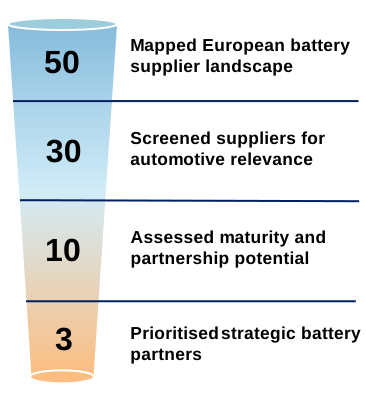
Our automotive client sought to map and prioritise European battery suppliers to support future vehicle electrification strategy. CamIn applied a structured landscape and filtering approach to identify 3 high-potential battery partners from over 50 suppliers.
Innovation Bridge
The client was advancing its electrification roadmap and required a clear view of the European battery supplier landscape to inform sourcing and partnership decisions. Visibility was fragmented, with uncertainty around technology maturity and supplier credibility.
They aimed to identify viable partners across battery chemistries, filtering out immature or niche solutions while ensuring alignment with automotive performance and scale.
The engagement reduced sourcing risk, accelerated partner selection, and enabled informed investment decisions, unlocking procurement efficiencies and strengthening long-term competitiveness.
50+ | Mapped a comprehensive European battery supplier landscape across established players and emerging innovators relevant to automotive applications. |
30 | Screened suppliers against automotive requirements including scalability, performance, and strategic fit to remove niche or immature technologies. |
10 | Assessed shortlisted suppliers in detail based on technical maturity, commercial readiness, and partnership potential aligned to client needs. |
3 | Prioritised high-potential partners with strong alignment on technology roadmap, scale, and integration into automotive platforms. |

CamIn screened over 50 suppliers and identified 3 high-priority partners aligned with automotive requirements and scalability criteria.
The client is now initiating partnership discussions and integrating shortlisted suppliers into its electrification strategy.
The work is expected to reduce supplier selection timelines by 30 percent and support multi-million-dollar procurement decisions.
Download our detailed case study to learn more about how CamIn and our hand-selected expert project team delivered these results for our client.

.svg)
The battery supplier landscape refers to the ecosystem of companies developing and manufacturing battery cells, modules, and materials for electric vehicles. It spans established manufacturers, emerging scale-ups, and technology innovators across lithium-ion and next-generation chemistries. For automotive OEMs, it includes not only cell producers but also upstream material providers and integration partners critical to securing reliable, high-performance battery supply.
Battery supply has become a strategic constraint for automotive manufacturers. It directly impacts vehicle cost, range, performance, and time to market. Limited supply, regional dependencies, and varying technology maturity create sourcing risk. A clear view of the supplier landscape enables OEMs to secure capacity, negotiate effectively, and align partnerships with long-term platform strategies while supporting regulatory and localisation requirements.
OEMs are increasingly forming direct partnerships with battery producers to secure supply and influence technology roadmaps. There is growing opportunity to diversify sourcing across Europe to improve resilience and reduce geopolitical exposure. Early engagement with emerging suppliers can provide access to cost advantages and differentiated performance. In parallel, vertical integration strategies and joint ventures are enabling tighter control over battery value chains and margins.
Short-term opportunities lie in securing production capacity through long-term offtake agreements with European cell manufacturers. Many OEMs underestimate the commercial leverage gained by committing early to capacity in exchange for pricing stability and priority allocation during shortages.
In the mid-term, localisation strategies are becoming critical. European gigafactory expansion is accelerating, but ramp-up risks remain high. OEMs can mitigate this by co-investing selectively in production lines or forming joint ventures, allowing them to influence quality standards and production timelines.
Long-term, the opportunity shifts towards partial vertical integration. OEMs that build internal capabilities in cell design and manufacturing oversight can capture margin and reduce dependency. This is particularly relevant as battery costs remain a dominant share of total vehicle cost.
In the near term, there is an opportunity to move upstream into raw material sourcing agreements, particularly for lithium, nickel, and graphite. Many OEMs still rely on tiered suppliers without visibility into material origin, exposing them to price volatility and supply disruption.
Mid-term, strategic partnerships with refining and processing players in Europe can improve traceability and ESG compliance. This is becoming a differentiator as regulatory scrutiny increases. Early movers are already locking in access to processed materials rather than raw extraction.
Long-term, circular supply models will become commercially relevant. OEMs that integrate recycling partnerships can reduce reliance on virgin materials and stabilise input costs. This also supports compliance with tightening sustainability requirements.
Short-term, diversifying across multiple battery suppliers reduces dependency risk and improves negotiation leverage. Many OEMs remain overly concentrated on a small number of large suppliers, limiting flexibility.
Mid-term, a portfolio approach across different chemistries allows OEMs to align battery selection with vehicle segments. For example, lower-cost chemistries can be deployed in entry-level vehicles, while higher-performance solutions support premium offerings.
Long-term, supplier portfolios will need to balance incumbent scale players with emerging innovators. Early engagement with scale-ups can provide access to differentiated performance or cost advantages, but requires structured risk management and staged investment approaches.
In the short term, closer collaboration with battery suppliers on pack integration can unlock incremental performance improvements without major redesign. Many gains remain untapped due to siloed development processes.
Mid-term, co-development of battery systems aligned to specific vehicle platforms can improve energy density, reduce weight, and optimise thermal management. This creates differentiation beyond the cell level.
Long-term, software integration and battery management systems will become a key value driver. OEMs that integrate hardware and software development can extend battery life, improve performance, and unlock new revenue streams through data-driven services.
Lithium-ion chemistries continue to evolve, with improvements in energy density, cost reduction, and safety through innovations in cathode and anode materials. Solid-state batteries are progressing towards commercial viability, offering potential gains in range and charging performance. Silicon-based anodes and alternative materials are gaining traction as near-term enhancements. Advances in manufacturing processes and recycling technologies are also improving supply security and lifecycle economics.
Lithium-ion remains the dominant technology, but significant innovation continues at the material level. High-nickel cathodes and silicon-enhanced anodes are improving energy density and reducing cost per kWh. These advancements offer near-term gains without requiring fundamental changes to manufacturing infrastructure.
The strength of this segment lies in its maturity and scalability. Supply chains are established, and incremental improvements can be rapidly commercialised. However, dependence on critical materials such as nickel and cobalt introduces cost volatility and ESG concerns.
Opportunities exist in selectively adopting chemistries based on vehicle segment requirements. The threat is that incremental improvements may not deliver sufficient step-change performance for future regulatory or consumer expectations, requiring parallel investment in next-generation technologies.
Solid-state batteries promise higher energy density, faster charging, and improved safety by replacing liquid electrolytes with solid materials. They are widely viewed as a potential step-change technology for electric vehicles.
Their strength lies in performance potential and safety benefits, which could enable longer range and simplified battery pack design. However, manufacturing complexity and scalability remain significant challenges. Many solutions are still at pilot stage, with uncertain timelines for mass production.
The opportunity for OEMs is early engagement with developers to secure future access and influence development priorities. The threat is overcommitting to technologies that may face delays or fail to scale economically within required timelines.
LFP batteries are gaining traction due to their lower cost, improved safety, and reduced reliance on scarce materials. While they offer lower energy density compared to high-nickel chemistries, they are increasingly suitable for mass-market vehicles.
The strength of LFP lies in cost stability and supply chain resilience. It enables OEMs to reduce vehicle costs and improve margins in price-sensitive segments. However, performance limitations may restrict use in premium or long-range vehicles.
Opportunities include deploying LFP strategically across entry-level models and fleet vehicles. The threat is commoditisation, as differentiation at the cell level becomes more limited, shifting competition towards system integration and cost efficiency.
Emerging materials such as silicon-dominant anodes and alternative cathode compositions are being developed to enhance energy density and charging performance. These technologies can be integrated into existing lithium-ion architectures, offering a bridge between current and future systems.
Their strength is compatibility with existing manufacturing processes, allowing incremental adoption. However, challenges remain around material stability, degradation, and lifecycle performance.
The opportunity lies in early adoption to gain performance advantages without waiting for full technology shifts. The threat is technical risk, as some materials may not meet durability requirements at scale, leading to potential reliability issues if adopted prematurely.
Recycling technologies are becoming increasingly important as battery volumes grow. Advanced processes enable recovery of critical materials, reducing reliance on raw material extraction. Second-life applications extend battery usage beyond automotive deployment.
The strength of this segment is its alignment with regulatory and sustainability pressures. It also offers potential cost benefits through material recovery. However, economics are still evolving, and scaling infrastructure remains a challenge.
Opportunities include integrating recycling into supply strategies to secure material access and improve ESG performance. The threat is delayed commercial viability, as profitability depends on scale and regulatory support.


