Case Study
Diversification strategy for electrified drivetrain capabilities
Leveraging drivetrain expertise to unlock adjacent markets and new growth


Leveraging drivetrain expertise to unlock adjacent markets and new growth
CamIn works with early adopters to identify new opportunities enabled by emerging technology.
of CamIn’s project team comprised of leading industry and technology experts


Our automotive client sought to identify and prioritise adjacent market opportunities by leveraging its core drivetrain and electrification capabilities. CamIn identified approximately 20 prioritised diversification opportunities across six industries, representing over $10 billion in addressable market.
Opportunity Compass
The client had strong performance in its core automotive markets but faced structural shifts driven by electrification and evolving mobility demands. This created urgency to identify new growth avenues beyond traditional segments.
The engagement aimed to systematically identify diversification opportunities that leveraged existing hardware capabilities while aligning with sustainability and circularity objectives. A structured assessment was required to navigate multiple applications.
The client sought a prioritised pipeline of opportunities with clear market potential, targeting multi-billion revenue pools and double-digit CAGR, enabling 5-10% incremental revenue growth within five years.

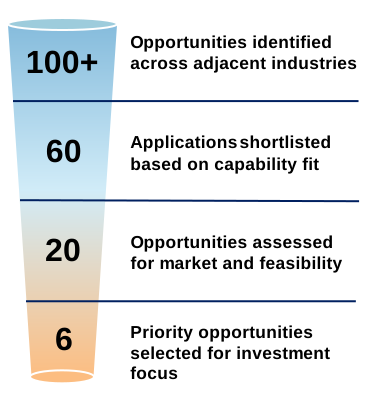
100+ | Cross-industry opportunities were mapped aligned with the client’s core hardware capabilities across electrification and drivetrain systems. |
60 | Capability-aligned applications were shortlisted through ESG alignment and strategic fit assessment to ensure feasibility and relevance. |
20 | High-potential opportunities were assessed using market sizing, CAGR analysis, competitive benchmarking, and technical feasibility evaluation. |
6 | Priority opportunities were selected based on commercial viability to form a clear pipeline for investment decisions and pilot development. |

CamIn identified and shortlisted 20 high-potential diversification opportunities across six industries, supported by market sizing and feasibility assessment.
The client is progressing selected opportunities into detailed business cases and pilot programmes aligned with its innovation roadmap.
The work underpins a potential £10-50 million revenue upside over five years, with improved capital allocation efficiency.
Download our detailed case study to learn more about how CamIn and our hand-selected expert project team delivered these results for our client.

.svg)
Diversification in this context refers to leveraging existing engineering capabilities, manufacturing assets, and supply chain strengths of automotive component manufacturers to enter adjacent industries and applications beyond traditional passenger vehicle markets.
This typically involves redeploying expertise in areas such as electrified powertrains, drivetrain systems, precision engineering, and thermal management into sectors where similar technical requirements exist. The objective is to create new revenue streams while reducing exposure to cyclical automotive demand and structural shifts such as electrification.
Automotive suppliers face structural pressure from electrification, reduced component complexity, and OEM-led vertical integration. Traditional revenue pools linked to internal combustion systems are declining, while margins are tightening across commoditised components.
Diversification enables suppliers to redeploy capabilities into higher-growth sectors, stabilise revenues, and improve asset utilisation. It also reduces dependency on a small number of OEM customers and provides access to markets with stronger pricing dynamics, including defence, industrial automation, and energy systems.
Critically, diversification is not only a growth lever but a resilience strategy. Companies that act early can capture attractive positions in emerging value chains, while late movers risk competing in saturated or commoditised segments.
Diversification opportunities are increasingly clustered around sectors that require high-performance mechanical and electrified systems. The most attractive opportunities combine technical adjacency with strong market growth and relatively low barriers to entry for established suppliers.
Off-highway electrification is advancing unevenly, creating targeted entry points for automotive suppliers. Quick wins include electrified auxiliary systems such as ePTOs, compact eDrive units, and hybrid retrofits for existing fleets. These applications require lower power density than passenger vehicles but benefit from proven automotive architectures.
Mid-term opportunities lie in full electrification of compact construction and agricultural machinery, where duty cycles are predictable and charging infrastructure can be controlled. Suppliers with drivetrain integration expertise can capture value by offering modular platforms rather than individual components.
Long-term opportunities are emerging in autonomous and semi-autonomous off-highway systems. These require integrated solutions combining electrification, actuation, and control systems. The competitive advantage shifts towards system-level integration rather than component supply, favouring players that can bundle hardware with software partnerships.
Industrial automation is a structurally growing market, but automotive suppliers are often under-positioned despite strong mechanical and motion control capabilities. Quick wins include supplying high-performance gearing, actuation components, and compact drive systems for collaborative robots and automated guided vehicles.
Mid-term opportunities focus on integrated subsystems such as modular drive units for warehouse automation and intralogistics. These systems prioritise reliability, cost efficiency, and ease of integration, areas where automotive-grade engineering provides an advantage.
Long-term value lies in supplying complete motion platforms or co-developing robotic systems with OEMs. However, this requires a shift towards shorter product cycles and closer collaboration with software providers. The key risk is margin compression if suppliers remain at component level without moving up the value chain.
Marine electrification is transitioning from niche to scalable applications, particularly in short-distance and inland shipping. Quick wins include supplying electric propulsion components for ferries, workboats, and port operations where regulatory pressure is highest.
Mid-term opportunities include hybrid propulsion systems and energy management solutions for medium-range vessels. Automotive suppliers can leverage battery integration, thermal management, and drivetrain expertise to enter these systems.
Long-term opportunities are linked to fully electric or hydrogen-powered vessels for larger segments. Entry barriers increase due to certification requirements and long asset lifecycles. However, early participation in pilot projects can position suppliers for future platform contracts with high switching costs and stable margins.
Defence mobility is increasingly electrified, driven by silent operation requirements and energy resilience. Quick wins include supplying electrified subsystems for auxiliary functions and hybrid drivetrains for specialised vehicles.
Mid-term opportunities involve full electrified drivetrain integration for tactical and logistics vehicles. These programmes require high durability and redundancy, aligning well with automotive engineering standards.
Long-term opportunities extend to integrated energy and mobility platforms, including hybrid power systems and energy storage solutions for field operations. While entry barriers are high, once secured, contracts tend to be long-term with limited competition.
The technology landscape enabling diversification is evolving rapidly, but the most relevant developments are those that can be integrated into existing manufacturing and engineering capabilities.
Modular eDrive systems are becoming increasingly standardised across industries. Their strength lies in scalability and adaptability, allowing suppliers to serve multiple sectors with limited redesign.
However, standardisation can lead to commoditisation if differentiation is not maintained. The opportunity lies in integrating these platforms into application-specific systems, combining hardware with control software and thermal management.
The threat is margin erosion as new entrants and low-cost manufacturers adopt similar architectures. Suppliers need to differentiate through integration, reliability, and lifecycle support rather than standalone components.
Advances in power electronics are enabling higher efficiency and compact system design. Automotive suppliers can leverage existing expertise but must adapt to different operating profiles in non-automotive applications.
The strength of this segment is its central role in electrification across industries. Weaknesses include rapid innovation cycles and high dependency on semiconductor supply chains.
Opportunities exist in offering integrated powertrain control solutions rather than discrete components. The threat is disintermediation by OEMs or technology specialists that control system architecture and software layers.
Hydrogen systems are gaining traction in heavy-duty and long-duration applications where batteries are less viable. Automotive suppliers can enter through balance-of-plant components such as compressors, valves, and drivetrain integration.
The strength lies in long-term decarbonisation potential and strong policy support. Weaknesses include infrastructure limitations and uncertain adoption timelines.
Opportunities are strongest in early-stage pilot projects and niche applications such as off-highway and marine. The risk is over-investment ahead of market maturity, requiring careful portfolio balancing between near-term and long-term bets.
Lightweight materials and advanced manufacturing techniques are enabling performance improvements across multiple sectors. Automotive suppliers already possess relevant capabilities in high-strength alloys and precision manufacturing.
The strength of this area is its cross-industry applicability, particularly in aerospace, defence, and robotics. Weaknesses include higher material costs and complex qualification processes.
Opportunities lie in offering differentiated components with performance advantages rather than competing on cost. The threat is that without proprietary material or process innovation, suppliers may struggle to sustain premium pricing.


