Case Study
Big data for smart meter analytics
Identifying and prioritising smart meter data opportunities for digital energy services


Identifying and prioritising smart meter data opportunities for digital energy services
CamIn works with early adopters to identify new opportunities enabled by emerging technology.
of CamIn’s project team comprised of leading industry and technology experts


An energy utilities client aimed to convert smart meter data into scalable digital products, identifying high-value use cases, enabling technologies, and new revenue streams while improving operational efficiency and customer engagement
AI, digitalisation, and automation
The client had deployed a large-scale smart meter network but was underutilising the data generated beyond billing.
They aimed to identify viable product and service opportunities that could monetise this data across B2B and B2C segments.
The engagement focused on quantifying value from improved demand forecasting, grid optimisation, and customer engagement, with the potential to unlock multi-million annual revenue uplift and operational cost reductions.
%20.jpg)
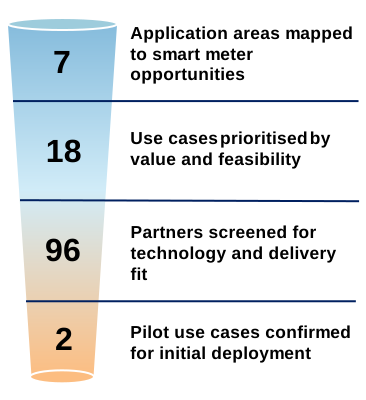
7 | Structured application areas mapped to align smart meter data capabilities with operational priorities and emerging digital service opportunities across B2B and B2C segments. |
18 | High-value use cases identified and prioritised based on commercial viability, customer demand, and feasibility of implementation using available smart meter infrastructure. |
96 | Potential partners and technologies assessed to identify relevant capabilities, including machine learning, data analytics, and smart grid solutions for scalable deployment. |
2 | Pilot use cases confirmed to test data-driven services, enabling early validation of business models and supporting transition towards commercial rollout. |

Identified 18 validated use cases across 7 application areas, enabling new digital products and operational improvements.
Client is developing internal tools and piloting machine learning-driven applications based on prioritised opportunities.
Estimated multi-million annual value through improved forecasting, grid efficiency, and new service revenues.
Download our detailed case study to learn more about how CamIn and our hand-selected expert project team delivered these results for our client.

.svg)
Smart meter data monetisation refers to the process of converting real-time electricity consumption data into commercially viable products, services, and operational insights. Utilities are increasingly treating smart meter infrastructure not only as a billing tool, but as a digital asset that can support new business models.
This includes leveraging advanced analytics, machine learning, and grid intelligence to improve forecasting, optimise network performance, and offer value-added services to both commercial and residential customers.
Smart meter data is becoming a strategic asset for utilities as they transition towards decentralised, data-driven energy systems. It enables granular visibility of consumption patterns, supporting more accurate demand forecasting, improved grid stability, and better integration of renewable energy sources.
From a commercial perspective, it opens pathways to new revenue streams beyond traditional energy supply. Utilities can move into data-driven services such as energy optimisation, demand response, and customer engagement platforms. It also supports regulatory compliance, particularly around efficiency targets and emissions reduction.
However, most utilities remain underutilising this data due to fragmented capabilities, unclear monetisation pathways, and concerns around cybersecurity and data governance.
Smart meter data is shifting utilities from asset operators to platform-based service providers. The most valuable opportunities sit at the intersection of operational efficiency, customer engagement, and new digital services.
Grid optimisation remains one of the most immediate and high-impact areas.
Quick-win opportunities include improving demand forecasting accuracy by integrating smart meter data with weather and behavioural datasets. This reduces balancing costs and improves procurement efficiency. Utilities can also optimise maintenance schedules using consumption anomalies as early indicators of network stress.
Mid-term opportunities focus on dynamic load management. By identifying localised demand peaks, utilities can deploy targeted interventions such as automated demand response or distributed storage. This reduces capital expenditure on grid expansion.
Long-term opportunities include fully digitised grid orchestration. Smart meter data becomes a core input for autonomous grid systems capable of real-time balancing across distributed energy resources. This supports higher penetration of renewables while maintaining reliability, which is increasingly critical under regulatory pressure.
Customer-facing services represent a significant but underdeveloped revenue stream.
Quick wins include offering consumption insights and benchmarking tools for residential and commercial customers. These are relatively simple to deploy and can improve retention and engagement.
Mid-term opportunities include personalised energy management services. Utilities can provide tailored recommendations, automated optimisation of appliances, and subscription-based energy efficiency services. For B2B customers, this extends to energy cost optimisation and reporting tools aligned with ESG requirements.
Long-term opportunities involve platform-based ecosystems. Utilities can position themselves as intermediaries for energy services, connecting customers with third-party providers such as solar installers, storage providers, or electric vehicle charging operators. This creates recurring revenue through platform fees and data services.
The growth of prosumers is reshaping electricity markets.
In the short term, utilities can offer tools to monitor and optimise self-generation for households and businesses with solar installations. This includes real-time visibility of generation versus consumption and basic export optimisation.
Mid-term opportunities include aggregation of distributed energy resources. Utilities can bundle prosumer capacity into virtual power plants, enabling participation in energy markets and ancillary services.
Long-term opportunities centre on peer-to-peer energy trading and local energy markets. Smart meter data becomes the backbone for validating transactions and balancing supply and demand at a local level. While still emerging, this model has the potential to shift utilities towards a platform role, with implications for pricing, regulation, and competitive positioning.
Smart meter data is increasingly relevant for short-term energy trading and flexibility services.
Quick wins include improved load forecasting, enabling more accurate bidding in wholesale markets and reducing imbalance penalties.
Mid-term opportunities involve participation in flexibility markets. Utilities can use aggregated smart meter data to offer demand response capacity, creating new revenue streams from grid services.
Long-term opportunities include integration with high-frequency trading strategies and automated market participation. While still niche, this could provide competitive advantage in highly dynamic energy markets, particularly as data latency and processing capabilities improve.
The value of smart meter data is closely tied to advances in analytics, connectivity, and system integration. Several technology segments are shaping how utilities extract and monetise this data.
Machine learning is central to extracting actionable insights from large volumes of smart meter data.
Its strength lies in pattern recognition across complex datasets, enabling accurate demand forecasting, anomaly detection, and customer segmentation. It supports scalable analytics that would not be feasible through traditional methods.
However, its effectiveness depends heavily on data quality and integration. Many utilities face challenges with fragmented data systems and limited internal capabilities, which can delay deployment.
The opportunity lies in embedding machine learning into core operations, from grid management to customer services. Utilities that build in-house capabilities or secure strong partnerships can gain a structural advantage in both efficiency and innovation.
Smart meter data is part of a broader Internet of Things ecosystem within the energy sector.
IoT platforms enable real-time data collection, integration, and control across distributed assets. This supports more responsive and flexible grid operations.
The strength of these platforms is their ability to connect diverse data sources, including meters, sensors, and distributed energy resources. However, interoperability remains a challenge, particularly in legacy systems.
Opportunities include creating unified data architectures that enable cross-functional use of data, from operations to commercial teams. Utilities that successfully integrate IoT platforms can accelerate innovation cycles and reduce operational silos.
As smart meter data becomes more valuable, cybersecurity and data governance are becoming critical enablers.
Strong data protection frameworks are essential to maintain customer trust and comply with regulatory requirements. This includes secure data transmission, storage, and access controls.
The challenge is balancing security with usability. Overly restrictive systems can limit data accessibility and slow down innovation.
Opportunities exist in adopting advanced cybersecurity solutions that enable secure data sharing across ecosystems. Utilities that establish robust governance frameworks can unlock partnerships and new business models while managing risk effectively.
Edge computing is emerging as a key enabler for processing smart meter data closer to the source.
Its main strength is reducing latency and bandwidth requirements, enabling real-time decision-making at the grid edge. This is particularly relevant for applications such as demand response and local grid balancing.
However, deployment can be complex and requires investment in distributed infrastructure.
The opportunity lies in combining edge computing with centralised analytics to create hybrid architectures. This allows utilities to process critical data in real time while leveraging cloud-based systems for deeper analysis. Such architectures are likely to underpin next-generation smart grids and digital energy platforms.


