Case Study
Reinforcement learning digital growth strategy
Defining reinforcement learning products and white space opportunities for revenue growth


Defining reinforcement learning products and white space opportunities for revenue growth
CamIn works with early adopters to identify new opportunities enabled by emerging technology.
of CamIn’s project team comprised of leading industry and technology experts


A global financial services firm engaged CamIn to identify reinforcement learning-enabled products, prioritise white space opportunities, and define a five-year innovation roadmap to unlock new revenue streams
Opportunity Compass
The client was performing strongly but lacked clarity on where reinforcement learning could deliver tangible commercial value across its service portfolio.
They sought to define a structured innovation roadmap, identifying credible use cases and products aligned to evolving client demand across industries.
The objective was to prioritise investments that could unlock new revenue streams, accelerate time to market, and capture high-value white space opportunities over a five-year horizon.

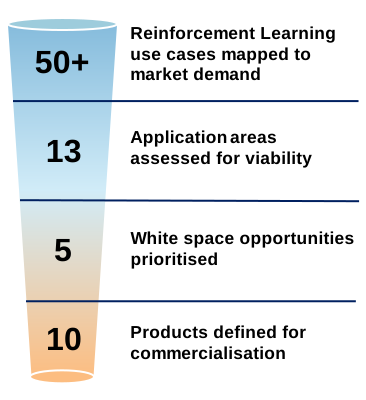
50+ | Use cases were identified through structured analysis of reinforcement learning applications across industries, aligned to evolving client demand and strategic growth priorities. |
13 | Application areas were assessed to distinguish mature and emerging opportunities based on technical feasibility, adoption barriers, and expected commercial value over time. |
5 | White space opportunities were prioritised by evaluating competitive positioning, unmet market needs, and the client’s ability to differentiate through reinforcement learning capabilities. |
10 | Products and services were defined with clear commercialisation pathways, including timelines, enabling technologies, and potential partners for deployment within 1, 3 and 5 years. |

Identified 10 prioritised reinforcement learning-enabled products and 5 high-potential white space opportunities aligned to market demand.
Client initiated investment in software and hardware capabilities and began engaging partners for product development.
Estimated $50-100 million medium-term revenue upside through new digital service offerings and accelerated market entry.
Download our detailed case study to learn more about how CamIn and our hand-selected expert project team delivered these results for our client.

.svg)
Reinforcement learning is a branch of artificial intelligence where algorithms learn by interacting with environments and improving decisions based on outcomes over time. Unlike traditional machine learning, which relies on static training data, reinforcement learning continuously adapts through feedback loops.
In financial services, this enables dynamic decision-making across complex, uncertain systems such as trading, risk management, pricing and operations. Its ability to optimise sequential decisions makes it particularly relevant for high-frequency, data-rich environments where conditions evolve continuously.
Financial services firms are under pressure to improve margins, optimise capital allocation and respond faster to market shifts. Traditional analytics approaches often struggle with dynamic, multi-variable decision environments where outcomes depend on sequences of actions rather than single predictions.
Reinforcement learning addresses this gap by enabling real-time optimisation across portfolios, processes and customer interactions. It allows firms to move from static models to adaptive systems that learn continuously, improving performance over time.
From a commercial perspective, this translates into more precise pricing, improved risk-adjusted returns, lower operational costs and new digital service offerings. It also creates differentiation in areas where incumbents typically rely on legacy systems and rule-based decision frameworks.
Reinforcement learning is moving from experimentation to targeted deployment. While broad adoption remains selective, specific domains are showing clear commercial traction and near-term viability.
In capital markets, reinforcement learning is increasingly applied to optimise trading strategies and portfolio allocation under uncertainty.
Quick-win opportunities focus on execution optimisation, where algorithms improve order timing, minimise slippage and reduce transaction costs. These use cases are already viable due to high-quality historical data and well-defined feedback signals.
Mid-term opportunities include dynamic portfolio rebalancing, where reinforcement learning can continuously adjust asset allocation in response to market conditions, risk constraints and liquidity considerations. This moves beyond static models towards adaptive portfolio management.
Long-term opportunities lie in fully autonomous trading systems that integrate macro signals, alternative data and real-time market feedback. These systems could significantly outperform traditional strategies but face regulatory scrutiny and model explainability challenges. Firms that build early capabilities in explainable reinforcement learning will have a structural advantage.
Risk management is traditionally rule-based and reactive. Reinforcement learning introduces the potential for proactive and adaptive risk optimisation.
Quick wins include credit risk optimisation, where reinforcement learning can refine lending decisions by balancing risk exposure and return across portfolios. Early deployments show improvements in approval rates without increasing default risk.
Mid-term applications focus on fraud detection and anti-money laundering, where reinforcement learning can adapt detection strategies based on evolving patterns rather than static thresholds. This reduces false positives and operational overhead.
Long-term opportunities involve enterprise-wide risk orchestration, where reinforcement learning coordinates risk decisions across business units in real time. The challenge is governance, as regulators require transparency. Firms that embed auditability and control mechanisms into their models will be better positioned to scale adoption.
Customer interaction models are shifting towards real-time personalisation, where reinforcement learning can optimise engagement strategies across channels.
Quick-win opportunities include marketing optimisation, where reinforcement learning improves targeting and timing of offers to increase conversion rates and reduce acquisition costs.
Mid-term use cases include dynamic pricing of financial products such as loans and insurance, where reinforcement learning can adjust pricing based on customer behaviour, risk profiles and competitive dynamics.
Long-term opportunities involve fully adaptive customer journeys, where reinforcement learning continuously optimises interactions across the lifecycle. This requires integration across systems and high-quality data governance, but offers significant uplift in customer lifetime value.
Operational efficiency remains a priority for financial institutions facing cost pressures and margin compression.
Quick wins include process optimisation in areas such as call centre routing and workflow management, where reinforcement learning improves resource allocation and reduces handling times.
Mid-term applications focus on treasury and liquidity management, where reinforcement learning can optimise capital allocation and funding strategies in response to market conditions.
Long-term opportunities include autonomous operations, where reinforcement learning manages end-to-end processes with minimal human intervention. While technically feasible, adoption will depend on organisational readiness and risk appetite.
The effectiveness of reinforcement learning depends on the maturity of underlying technologies. Several key enablers are shaping how quickly firms can deploy and scale these solutions.
Modern frameworks are enabling faster development and deployment of reinforcement learning applications.
Strengths include modular architectures, integration with cloud platforms and support for distributed training, allowing firms to scale experimentation efficiently. Open-source ecosystems are accelerating innovation and reducing entry barriers.
Weaknesses include complexity in implementation and a shortage of skilled talent capable of deploying models in production environments.
Opportunities lie in building internal platforms that standardise development and reduce time to deployment. Firms that industrialise reinforcement learning workflows can move faster than competitors.
Threats include over-reliance on immature tools that may not meet enterprise-grade requirements, particularly in regulated environments.
Reinforcement learning often requires environments where models can safely learn through trial and error. Simulation and digital twins are critical in enabling this.
Strengths include the ability to test strategies without real-world risk and to model complex systems such as markets or customer behaviour.
Weaknesses relate to the accuracy of simulations. Poorly calibrated environments can lead to suboptimal or misleading outcomes when deployed in reality.
Opportunities include using digital twins of financial systems to test new strategies before live deployment, reducing risk and accelerating innovation cycles.
Threats arise when firms underestimate the effort required to build high-fidelity simulations, leading to delays or failed deployments.
Explainability is becoming a critical requirement, particularly in regulated sectors such as financial services.
Strengths include emerging techniques that make reinforcement learning decisions more interpretable, supporting compliance and governance.
Weaknesses remain significant, as many reinforcement learning models are inherently complex and difficult to explain compared to traditional models.
Opportunities lie in developing explainability as a competitive advantage, enabling faster regulatory approval and broader adoption across high-impact use cases.
Threats include regulatory constraints slowing down deployment, particularly for applications involving customer outcomes or financial risk.
Infrastructure is often the limiting factor in scaling reinforcement learning beyond pilot projects.
Strengths of modern cloud and edge computing include scalability, flexibility and integration with existing data platforms.
Weaknesses include cost and complexity, particularly when managing large-scale training and real-time inference.
Opportunities exist in aligning reinforcement learning with broader digital transformation programmes, leveraging existing investments in data and AI infrastructure.
Threats include fragmented architectures that prevent seamless integration, limiting the ability to move from experimentation to production.


