Case Study
HVO suppliers for construction projects
Targeted supplier landscaping to enable HVO adoption across US construction operations.


Targeted supplier landscaping to enable HVO adoption across US construction operations.
CamIn works with early adopters to identify new opportunities enabled by emerging technology.
of CamIn’s project team comprised of leading industry and technology experts


Our infrastructure client sought to identify and validate HVO fuel suppliers to accelerate sustainable construction operations in the United States. CamIn identified 6 validated HVO suppliers from 22 candidates to enable rapid pilot deployment across 6 US states.
Innovation Bridge
The client aimed to improve sustainability performance across its US construction operations, building on prior success in Europe. It sought to transition to low-carbon fuels while staying ahead of evolving state-level regulations.
CamIn was engaged to identify credible HVO suppliers and assess regulatory feasibility across key markets. The objective was to enable rapid pilot deployment while reducing supplier risk and ensuring compliance. This would support emissions reduction targets and strengthen competitiveness in sustainability-driven tenders.
%20.jpg)
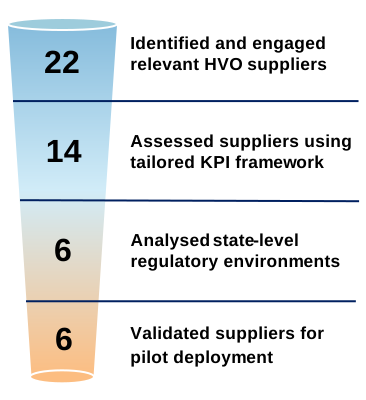
22 | A targeted market scan identified and engaged relevant HVO suppliers across production and distribution aligned to construction sector requirements and geographic priorities. |
14 | A structured KPI framework was developed to evaluate supplier capabilities, scalability, regulatory compliance, logistics performance and commercial fit against client-specific requirements. |
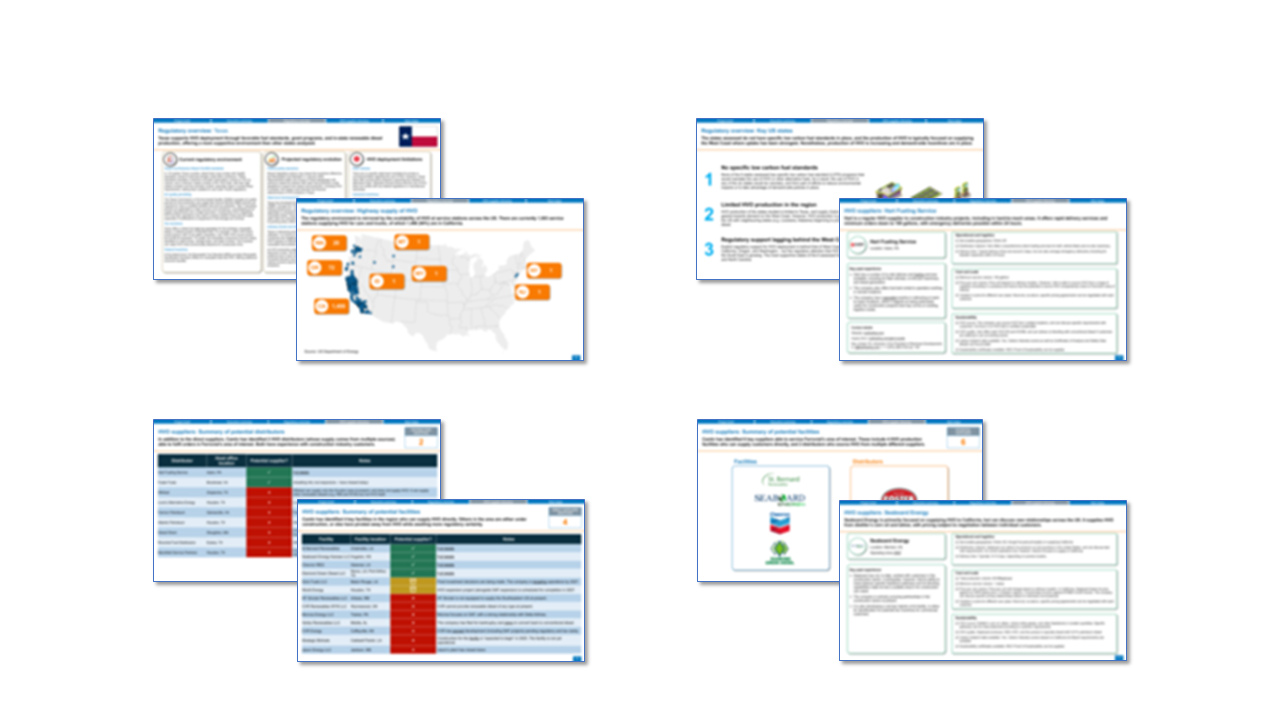
6 | A detailed regulatory analysis across six US states assessed current policies, incentives and expected developments impacting HVO deployment feasibility over the next five years. |
6 | Final suppliers were validated through direct engagement and KPI scoring, enabling confident selection of partners for immediate pilot deployment across construction sites. |

6 high-quality HVO suppliers shortlisted from 22 candidates, enabling immediate pilot readiness across multiple construction sites.
The client is now negotiating pilot agreements and integrating HVO into its operational decarbonisation roadmap.
Estimated multi-million dollar emissions reduction impact and improved bid competitiveness for sustainability-led infrastructure projects.
Download our detailed case study to learn more about how CamIn and our hand-selected expert project team delivered these results for our client.

.svg)
Hydrotreated Vegetable Oil (HVO) is a renewable diesel alternative produced from waste oils, animal fats and vegetable feedstocks through hydrotreatment. It is chemically similar to fossil diesel, enabling direct use in existing engines without modification. For construction firms operating large diesel-powered fleets, HVO provides a practical pathway to reduce lifecycle emissions while maintaining operational continuity. It is typically deployed through existing fuel infrastructure, making it one of the most immediately actionable decarbonisation levers available.
More broadly, low-carbon fuels in construction refer to alternative energy carriers that reduce greenhouse gas emissions without compromising equipment performance or site productivity. These include HVO, biodiesel blends, renewable natural gas, hydrogen and electrified systems. Among these, HVO stands out as a near-term solution due to its compatibility, scalability and regulatory alignment.
Construction remains one of the most carbon-intensive sectors, driven by heavy reliance on diesel-powered equipment, logistics fleets and on-site power generation. Regulatory pressure is increasing, particularly at state and federal levels in the United States, where incentives and emissions standards are becoming more stringent. Firms that fail to adapt risk higher compliance costs, reduced access to public tenders and reputational exposure.
Low-carbon fuels such as HVO offer a commercially viable route to immediate emissions reduction, often achieving up to 90 percent lifecycle CO2 savings compared to fossil diesel. This enables firms to meet ESG targets without waiting for full electrification or hydrogen infrastructure to mature. Importantly, the ability to deploy without retrofitting equipment reduces capital expenditure and avoids operational disruption.
From a strategic perspective, early adoption supports competitive differentiation in sustainability-led bids, improves resilience against future fuel restrictions, and strengthens alignment with investor and stakeholder expectations. It also provides a platform for phased transition to more advanced energy systems as they become viable.
The transition to low-carbon fuels is creating a layered opportunity landscape across supply, operations and commercial positioning. While HVO is already deployable, its strategic value varies depending on how firms integrate it into broader decarbonisation strategies.
The supply side of HVO is still fragmented, particularly in the United States, where production capacity and distribution infrastructure vary significantly by region. In the short term, construction firms can secure competitive advantage by establishing early partnerships with regional suppliers and locking in supply agreements before demand accelerates. This is particularly relevant in states with emerging incentive structures.
In the mid-term, opportunities lie in co-investment or strategic partnerships with fuel producers and distributors. Firms can influence supply chain reliability, pricing structures and logistics integration. This is especially valuable for large-scale infrastructure projects requiring consistent fuel availability across multiple sites.
In the long term, vertical integration or long-term offtake agreements may become critical as competition for sustainable fuels intensifies across sectors such as aviation and heavy transport. Firms that secure preferential access to supply will be better positioned to scale operations without cost volatility.
From an operational perspective, HVO enables immediate decarbonisation of existing fleets without capital-intensive upgrades. In the short term, firms can deploy HVO across high-usage assets such as excavators, generators and transport vehicles to achieve rapid emissions reductions and demonstrate measurable ESG impact.
In the mid-term, data-driven optimisation of fuel usage becomes important. Firms can integrate fuel consumption analytics with operational planning to maximise efficiency gains and quantify emissions savings. This creates a foundation for more sophisticated energy management strategies.
In the long term, HVO serves as a bridge to hybrid and fully electrified fleets. Firms that combine HVO deployment with electrification pilots can balance short-term emissions reduction with long-term transformation, avoiding stranded assets while maintaining operational flexibility.
Regulation is a key driver of HVO adoption, with significant variation across states. In the short term, firms can capture value by aligning operations with regions offering favourable incentives or credits for renewable fuel use. This can directly impact project economics and bid competitiveness.
In the mid-term, proactive regulatory monitoring enables firms to anticipate changes and adapt procurement strategies accordingly. This includes understanding carbon intensity scoring systems, tax credits and reporting requirements that affect total cost of ownership.
In the long term, regulatory alignment will become a prerequisite for market access, particularly in public infrastructure projects. Firms that embed compliance into their operating model early will reduce risk and avoid costly retrofits or operational constraints.
Sustainability is increasingly influencing procurement decisions in infrastructure projects. In the short term, the use of low-carbon fuels can strengthen bid positioning by demonstrating immediate emissions reduction capability without project delays.
In the mid-term, firms can develop differentiated service offerings, such as low-carbon construction packages or carbon-neutral project delivery models. These can command premium pricing in certain segments, particularly where clients have strict ESG targets.
In the long term, the ability to quantify and verify emissions reductions will become a core commercial capability. Firms that invest in transparent reporting and certification will be better positioned to capture value from sustainability-linked contracts and financing structures.
The low-carbon fuel landscape is evolving rapidly, with multiple technologies competing across different time horizons. Each presents distinct strategic implications in terms of cost, scalability and infrastructure requirements.
HVO is currently the most commercially viable low-carbon fuel for construction. Its key strength lies in full compatibility with existing diesel engines and infrastructure, enabling immediate deployment. This reduces both capital expenditure and operational risk.
However, supply constraints and feedstock availability remain critical limitations. As demand increases across sectors, pricing volatility and competition for feedstock could impact long-term economics. There are also sustainability concerns linked to feedstock sourcing, particularly where virgin oils are used.
The opportunity lies in early adoption and supplier partnerships. Firms that secure reliable supply and integrate HVO into their operations now can achieve immediate emissions reductions while building internal capabilities for managing alternative fuels.
Biodiesel blends are widely available and offer a lower-cost entry point into renewable fuels. They can be used in existing engines up to certain blend levels, making them accessible for gradual adoption.
However, biodiesel has limitations in terms of stability, storage and compatibility at higher blend ratios. Performance issues in cold climates and potential engine wear can also restrict its use in demanding construction environments.
Despite these challenges, biodiesel remains relevant as a transitional solution. It can be used strategically in less critical applications or as part of a phased approach to fuel transition. Firms can leverage it to build internal processes and supply chain relationships before scaling to more advanced fuels.
Hydrogen represents a long-term decarbonisation pathway, particularly for heavy-duty equipment. It offers zero tailpipe emissions when used in fuel cells and can be produced from renewable sources.
The primary challenge is infrastructure. Hydrogen production, storage and distribution systems are still under development, and costs remain high. Equipment compatibility is also limited, requiring new machinery or significant modifications.
The opportunity lies in early pilot projects and strategic partnerships. Firms that engage with hydrogen ecosystems now can position themselves for future adoption, particularly in regions where infrastructure investment is accelerating.
Battery-electric and hybrid systems are gaining traction, particularly for smaller equipment and urban construction sites. They offer zero on-site emissions and reduced noise, which can be advantageous in regulated environments.
However, limitations in battery capacity, charging infrastructure and upfront cost restrict their applicability for heavy-duty or remote operations. Downtime associated with charging can also impact productivity.
The strategic opportunity is in targeted deployment. Firms can use electrification in specific use cases where it delivers clear operational or regulatory benefits, while relying on HVO or other fuels for heavy-duty applications. This hybrid approach enables a balanced transition without compromising performance.
Renewable natural gas and other alternative fuels offer incremental emissions reductions and can be integrated into existing systems with moderate adjustments. They are particularly relevant for fleet vehicles and certain stationary applications.
Their limitations include infrastructure dependency and lower emissions reduction potential compared to HVO or hydrogen. Adoption is also influenced by regional availability and regulatory incentives.
These fuels can play a complementary role in a diversified energy strategy. Firms can use them to optimise cost and supply resilience, particularly in regions where HVO availability is constrained.


