Case Study
Sustainability services strategy for automotive growth
Prioritising sustainability service opportunities aligned with capabilities and revenue potential


Prioritising sustainability service opportunities aligned with capabilities and revenue potential
CamIn works with early adopters to identify new opportunities enabled by emerging technology.
of CamIn’s project team comprised of leading industry and technology experts


Our automotive client sought to expand into sustainability-driven services and identifying scalable opportunities aligned with circular economy trends. CamIn went through its proprietary process to identify 8 high-impact sustainability services, supporting a £20 million investment.
Opportunity Compass
The client had a strong hardware base but faced pressure to address rising demand for sustainability and circularity. Leadership recognised the need to diversify into higher-value services aligned with evolving regulations and customer expectations.
They aimed to identify service-based growth opportunities leveraging existing capabilities, assets, and data, including software, lifecycle services, and circular models.
The client sought to de-risk a multi-year investment by prioritising commercially viable opportunities, aiming to unlock new revenue streams, improve asset utilisation, and capture £50 million in revenue upside.

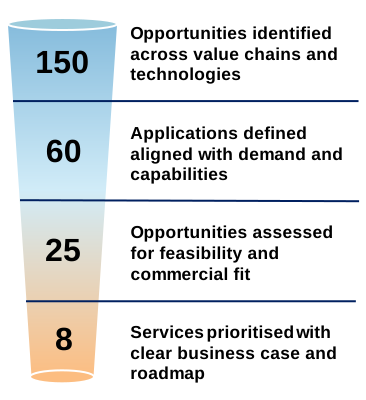
150+ | Sustainability opportunities identified through structured analysis of value chains, emerging technologies, and expert insights across automotive and adjacent ecosystems. |
60 | Priority applications defined by clustering opportunities into distinct service areas aligned with customer needs, regulatory trends, and internal capabilities. |
25 | Commercial opportunities assessed through evaluation of technical feasibility, market demand, and business viability to determine scalability and strategic fit. |
8 | High-impact services prioritised based on quantified business cases, implementation feasibility, and alignment with growth and sustainability objectives. |

Identified and prioritised a portfolio of high-potential sustainability services, including predictive maintenance, lifecycle management, and circularity solutions.
The client is progressing selected opportunities into pilot phase and aligning internal teams around a service-led growth roadmap.
Enabled more confident allocation of a £20 million investment, with potential to generate £50 million+ in new revenues over 5 years.
Download our detailed case study to learn more about how CamIn and our hand-selected expert project team delivered these results for our client.

.svg)
Sustainability services in the automotive sector refer to service-led offerings that reduce environmental impact while improving lifecycle value of vehicles and components. These include predictive maintenance, battery lifecycle management, remanufacturing, circular logistics, and data-driven optimisation services.
The focus shifts from selling components to delivering outcomes such as extended asset life, reduced emissions, and improved resource efficiency. This enables suppliers and OEMs to monetise lifecycle performance and strengthen long-term customer relationships.
Automotive players face sustained margin pressure due to electrification, volatile raw material costs, and tightening regulatory requirements. At the same time, customers increasingly expect solutions that reduce total cost of ownership and environmental impact.
Sustainability services provide a pathway to capture higher-margin, recurring revenues while supporting compliance with ESG targets. They also enable better utilisation of existing assets, reducing dependency on new production. Companies that fail to expand into services risk losing relevance as value shifts towards software, data, and lifecycle management.
Sustainability services in automotive are expanding beyond isolated initiatives into structured, scalable business models. The most attractive opportunities combine existing engineering strengths with digital capabilities and access to installed assets. Value is emerging across the full vehicle lifecycle, from usage optimisation to end-of-life recovery, with clear differentiation between near-term monetisation and longer-term platform-based plays.
Battery lifecycle services are emerging as a critical value driver, particularly with the rapid growth of electric vehicles.
Quick wins include diagnostics and health monitoring services that optimise battery performance and extend usable life. These can often be deployed using existing telematics and require limited hardware changes.
Mid-term opportunities focus on battery refurbishment and second-life applications, such as repurposing EV batteries for stationary energy storage. These require new capabilities in testing, grading, and logistics, but unlock additional revenue from assets that would otherwise be scrapped.
Long-term, integrated battery lifecycle platforms could manage tracking, reuse, and recycling at scale, creating closed-loop ecosystems. The strategic implication is significant control over material flows and reduced exposure to raw material volatility.
Predictive maintenance services are among the most commercially mature sustainability services in automotive.
Quick wins involve leveraging existing sensor data to reduce unplanned downtime and optimise maintenance schedules. Many suppliers already collect data but have not fully commercialised it.
Mid-term opportunities include offering uptime guarantees and performance-based contracts, particularly for fleet operators. This requires more advanced analytics and integration with customer systems.
Long-term, predictive maintenance becomes part of fully autonomous service ecosystems, where vehicles and components self-monitor and trigger interventions. This creates high switching costs and strengthens long-term customer relationships while reducing lifecycle emissions through better asset utilisation.
Remanufacturing is gaining traction as both a cost and sustainability lever, particularly for high-value components.
Quick wins include scaling existing remanufacturing programmes, often constrained by inefficient reverse logistics and inconsistent supply of used components.
Mid-term opportunities involve redesigning products for disassembly and reuse, improving recovery rates and reducing processing costs. This requires alignment between engineering, procurement, and aftermarket functions.
Long-term, fully circular component systems could emerge, where products are continuously recovered, refurbished, and redeployed. This reduces dependency on virgin materials and supports compliance with tightening circularity regulations, while improving margins through lower input costs.
As regulatory requirements increase, data-driven services are becoming essential.
Quick wins include providing basic reporting tools for emissions, usage, and compliance, often using data already collected within vehicles and systems.
Mid-term opportunities involve advanced analytics services that help customers optimise energy use, track carbon footprints, and meet regulatory requirements across regions.
Long-term, lifecycle data platforms could become central to ecosystem coordination, integrating OEMs, suppliers, recyclers, and regulators. Companies that control these platforms can capture high-margin digital revenues and influence industry standards.
The shift towards sustainability services is underpinned by a set of enabling technologies that are maturing at different speeds. While many are already deployed in isolation, competitive advantage increasingly depends on how effectively they are integrated into scalable service offerings. The following technologies are shaping both near-term execution and longer-term strategic positioning across the automotive value chain.
Connected vehicle systems provide the data foundation for most sustainability services.
Strengths include real-time visibility into asset performance and relatively high maturity across many vehicle platforms. Weaknesses include fragmented standards and integration challenges across OEMs and suppliers.
Opportunities lie in monetising data through services such as predictive maintenance and compliance reporting. However, companies risk losing control of data value if third-party platforms dominate the ecosystem.
AI enables deeper insights into vehicle and component performance, supporting predictive and prescriptive services.
Strengths include improved accuracy in forecasting failures and optimising operations. Weaknesses include dependency on high-quality data and specialised talent.
Opportunities include outcome-based service models and differentiated offerings. The main threat is capability gaps, where companies cannot scale analytics fast enough to compete.
Technologies for battery testing, grading, and recycling are rapidly evolving alongside EV adoption.
Strengths include strong alignment with regulatory trends and growing market demand. Weaknesses include technical complexity and evolving standards.
Opportunities include capturing value across the battery lifecycle, from first use to second life and recycling. Companies that build early capabilities can secure strategic positions in future supply chains.
Digital twins enable virtual modelling of vehicles and components across their lifecycle.
Strengths include improved decision-making and optimisation without physical intervention. Weaknesses include high implementation costs and integration complexity.
Opportunities include enhanced service offerings and better lifecycle planning. Over time, digital twins can become a core component of service-based business models.
Efficient reverse logistics is critical for scaling sustainability services.
Strengths include potential cost savings and improved material recovery. Weaknesses include fragmented infrastructure and coordination challenges.
Opportunities lie in building closed-loop supply chains that reduce material costs and improve resilience. However, execution requires strong partnerships and operational discipline.


