Case Study
Food innovation for nutritional disorders
Targeted product and technology strategy for specialised healthcare nutrition growth


Targeted product and technology strategy for specialised healthcare nutrition growth
CamIn works with early adopters to identify new opportunities enabled by emerging technology.
of CamIn’s project team comprised of leading industry and technology experts


A food manufacturer sought to expand into healthcare nutrition by identifying viable product opportunities and enabling technologies, resulting in 8 product concepts and de-risking a $10 million innovation investment.
Horizon & Portfolio Scanner
The client had an established presence in healthcare meals but faced underperformance in addressing patients with complex nutritional disorders.
They aimed to develop a differentiated product portfolio tailored to specific clinical needs and expand into adjacent healthcare and hospitality channels.
The engagement focused on identifying high-value product opportunities and enabling technologies, targeting a de-risked $10 million investment while improving product-market fit and accelerating innovation success rates.
%20(1).jpg)
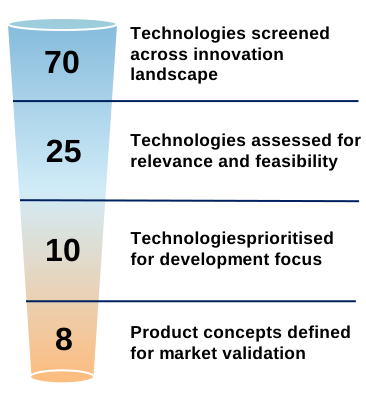
70 | Technologies were screened across ingredients, formulations and processing to map the full innovation landscape relevant to nutritional disorders. |
25 | Technologies were assessed for clinical relevance, scalability and integration with existing production processes. |
10 | Technologies were prioritised based on feasibility, commercial potential and alignment with targeted patient needs. |
8 | Product concepts were defined translating technologies into actionable opportunities ready for development and market validation. |

Identified 8 high-potential product opportunities and 10 enabling technologies aligned with clinical needs and manufacturing feasibility.
The client is progressing into product development and validating technology partnerships for commercial launch.
De-risked a $10 million investment and accelerated time-to-market, with potential multi-million annual revenue upside.
Download our detailed case study to learn more about how CamIn and our hand-selected expert project team delivered these results for our client.

.svg)
Clinical nutrition for patients with nutritional disorders refers to the development and delivery of food products tailored to individuals with medical conditions that affect their ability to consume, digest, or absorb nutrients. This includes dysphagia, malnutrition, metabolic disorders, and age-related nutritional decline.
Unlike standard food innovation, this segment requires alignment between clinical outcomes, regulatory requirements, and manufacturability. Products must meet precise nutritional profiles while addressing texture, safety, and patient adherence. It sits at the intersection of food science, healthcare delivery, and large-scale production.
Healthcare providers are under pressure to improve patient outcomes while reducing cost burdens. Nutrition is increasingly recognised as a critical factor in recovery, with poor nutrition linked to longer hospital stays and higher complication rates. In some cases, inadequate nutrition can increase treatment costs by an estimated 20 to 30 percent.
For food manufacturers, clinical nutrition offers a structurally growing market driven by ageing populations and rising chronic disease prevalence. It enables premium product positioning and long-term supply agreements with healthcare providers. However, success depends on combining clinical relevance with scalable manufacturing and regulatory compliance.
Clinical nutrition is shifting from a niche offering to a strategic growth area. The most compelling opportunities are those that combine unmet patient needs with operational feasibility and clear commercial pathways.
Hospitals are increasingly linking nutrition to patient outcomes, yet many still rely on standardised meal solutions that lack clinical specificity.
Quick wins include reformulating existing meal portfolios to address dysphagia and malnutrition through texture adaptation and nutrient enrichment. These improvements can often be implemented within current production systems.
Mid-term opportunities involve developing condition-specific meal ranges aligned with clinical pathways, such as post-operative recovery or oncology care. These products can be embedded into procurement frameworks, creating predictable demand.
Long-term potential lies in integrating nutrition into patient care systems, where meals are adapted based on clinical data. This creates opportunities for deeper partnerships with healthcare providers and stronger competitive positioning.
The elderly care segment represents a scalable and under-served opportunity. A significant proportion of residents experience malnutrition or swallowing difficulties, yet food solutions remain largely standardised.
Quick wins include introducing high-protein, easy-to-consume meals that improve nutritional intake without increasing portion size. These products can support better health outcomes while justifying modest price premiums.
Mid-term opportunities include modular meal systems that allow care providers to tailor nutrition to individual needs while maintaining operational efficiency.
Long-term opportunities are emerging in preventative nutrition, where targeted diets support healthy ageing and delay the onset of chronic conditions. This shifts the value proposition from reactive care to long-term health management.
Hospitality providers are increasingly expected to cater for guests with specific dietary and medical needs, yet few have the capability to deliver clinically appropriate meals at scale.
Quick wins include ready-to-serve specialised meal options that integrate into existing menus with minimal operational change. This enables differentiation in healthcare-linked hospitality environments.
Mid-term opportunities include partnerships with clinical nutrition providers to offer certified or clinically informed menus, strengthening credibility and market positioning.
Long-term potential includes integrated nutrition services within hospitality settings, particularly in wellness, rehabilitation, and long-stay environments. This opens new revenue streams while improving customer retention.
Retail channels are beginning to reflect clinical nutrition trends as consumers become more aware of the link between diet and health conditions.
Quick wins include extending existing product lines with fortified or condition-specific variants, such as high-protein meals or texture-modified foods.
Mid-term opportunities involve dedicated product ranges targeting specific conditions, supported by clear labelling and clinical validation. This supports premium pricing and brand differentiation.
Long-term opportunities include personalised nutrition platforms that combine consumer data with tailored product recommendations. While complex, this approach could reshape product development and marketing strategies.
Technology is central to translating clinical requirements into scalable products. The most relevant developments bridge formulation science, processing capability, and measurable patient outcomes.
Emerging formulation techniques allow precise control over nutrient composition, texture, and stability. This includes protein fortification systems, hydrocolloids for texture control, and encapsulation technologies for nutrient delivery.
Strengths include the ability to meet specific clinical requirements while maintaining taste and shelf life. Weaknesses include higher ingredient costs and formulation complexity, particularly at scale.
Opportunities lie in developing differentiated, clinically validated formulations that support premium positioning. However, reliance on specialised inputs can create supply chain risks if not managed carefully.
Technologies that modify food texture while preserving nutritional value are critical for patients with swallowing difficulties.
Strengths include strong and growing demand, particularly in elderly care and hospital settings, with relatively clear clinical use cases.
Weaknesses include challenges in maintaining product appeal, as texture-modified foods can be perceived as less desirable by patients.
Opportunities exist in improving sensory quality and standardising texture frameworks across markets. Companies that enhance both safety and experience can unlock significant growth.
Advances in processing, including low-temperature cooking, extrusion, and precision mixing, are enabling efficient production of specialised nutrition products.
Strengths include improved consistency, scalability, and compliance with hygiene standards. These technologies also support more complex formulations.
Weaknesses include capital investment requirements and integration challenges with existing production lines.
Opportunities lie in selectively upgrading facilities to support clinical nutrition production without full system replacement. This enables faster commercialisation while controlling capital expenditure.
Data-driven approaches are emerging to link nutrition directly to patient outcomes. This includes tools that monitor nutritional intake and its impact on recovery or disease progression.
Strengths include the ability to demonstrate measurable value to healthcare providers, supporting stronger commercial propositions and long-term contracts.
Weaknesses include integration complexity, data privacy considerations, and the need for collaboration across healthcare systems.
Opportunities include aligning nutrition products with reimbursement models and clinical protocols. Companies that build capabilities in clinical validation and data integration will be better positioned to secure strategic partnerships.


