Case Study
Utility asset monetisation strategy
Identifying and prioritising asset-based revenue opportunities for utility growth


Identifying and prioritising asset-based revenue opportunities for utility growth
CamIn works with early adopters to identify new opportunities enabled by emerging technology.
of CamIn’s project team comprised of leading industry and technology experts


A utility client engaged CamIn to identify and prioritise new asset-driven revenue opportunities, resulting in 5 high-value business cases with up to $5 million revenue potential
White space & diversification strategy
The client had a strong asset base but was not fully capturing its commercial potential beyond core operations. They sought a structured approach to identify new products and services aligned with emerging market and regulatory trends.
The objective was to prioritise high-value opportunities and build credible business cases. The engagement aimed to unlock up to $5 million in new revenue while reducing uncertainty around a planned multi-million-dollar investment portfolio.

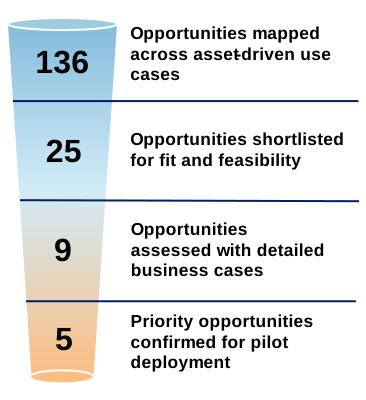
136 | Opportunity areas identified through structured mapping of asset-driven use cases across market demand, regulatory trends, and adjacent industry applications. |
25 | Opportunities shortlisted based on strategic fit, feasibility, and alignment with existing capabilities and infrastructure. |
9 | Opportunities assessed in detail through commercial validation, capability gap analysis, and development of robust financial business cases. |
5 | Priority opportunities confirmed with clear value propositions, ROI scenarios, and defined pathways for near-term pilot deployment. |

Identified 5 high-priority business opportunities from 136 initial concepts, supported by validated ROI scenarios and clear routes to market.
The client is advancing pilot projects and refining go-to-market strategies for selected opportunities.
De-risked a potential $5 million investment, delivering a strong return on a relatively modest project cost.
Download our detailed case study to learn more about how CamIn and our hand-selected expert project team delivered these results for our client.

.svg)
Utility asset monetisation refers to the structured process of generating new revenue streams from existing infrastructure, land, and operational capabilities beyond core regulated activities. This includes leveraging physical assets such as substations, rights-of-way, fleet, and data to deliver new products and services.
Rather than relying solely on traditional tariff-based income, utilities are increasingly exploring adjacent commercial models. These may include leasing land, enabling third-party services, or offering new customer-facing solutions. The focus is on extracting incremental value without significant new capital expenditure.
Utilities face structural pressure on margins due to regulatory constraints, capital intensity, and the transition towards decentralised energy systems. At the same time, they hold extensive asset bases that are often underutilised from a commercial perspective.
Asset monetisation provides a pathway to diversify revenue while improving return on capital employed. It enables utilities to participate in emerging value pools such as distributed energy, mobility infrastructure, and digital services without fundamentally altering their core operations.
For leadership teams, the importance lies in balancing risk and growth. Monetisation strategies allow incremental innovation with relatively low downside, particularly when anchored in existing capabilities. This is increasingly relevant as utilities seek to justify capital allocation and demonstrate growth beyond regulated returns.
Utilities are beginning to recognise that value lies not only in energy delivery, but in the broader ecosystem built around their infrastructure. The opportunity space is expanding across multiple asset classes, each with distinct timelines and risk profiles.
Utility land portfolios, including substations and rights-of-way, are often strategically located but commercially underutilised. These assets can support a range of adjacent use cases if regulatory and operational constraints are properly managed.
Quick wins include leasing land for telecommunications infrastructure such as fibre and small cell deployments. These opportunities require minimal operational change and offer predictable income streams. Mid-term opportunities include co-locating distributed energy assets such as solar or battery storage, either independently or through partnerships.
Long-term opportunities are emerging in areas such as hydrogen infrastructure and multi-use energy hubs. These require more complex permitting and integration but can position utilities within future energy systems. The key challenge lies in balancing safety, regulatory compliance, and commercial returns, particularly where land use conflicts may arise.
Utility fleets represent a significant but often overlooked monetisation opportunity. Vehicles and mobile equipment are increasingly becoming platforms for additional services, particularly as electrification and connectivity increase.
In the near term, fleets can support services such as mobile charging, equipment rental, or third-party logistics support during off-peak utilisation. These opportunities are operationally straightforward but require coordination and asset tracking.
Mid-term, electrified fleets can be integrated into grid services, providing demand response or distributed storage capabilities. This creates a dual revenue stream, combining operational use with grid participation.
Long-term, autonomous and connected fleet systems may enable new service models, including infrastructure inspection as a service or integrated mobility solutions. The complexity lies in data integration, regulatory approval, and ensuring that core operational reliability is not compromised.
Utilities generate large volumes of operational and customer data, much of which remains underutilised commercially. As digital infrastructure improves, this data becomes a valuable asset in its own right.
Short-term opportunities include offering aggregated insights to commercial and municipal customers, particularly in areas such as energy efficiency and asset performance. These are relatively low risk but require careful handling of privacy and regulatory considerations.
Mid-term, utilities can develop digital platforms that enable third-party services, such as energy management or predictive maintenance. This shifts the utility towards a platform-based model, capturing value from ecosystem participation.
Long-term, integration with smart city infrastructure and cross-sector data exchanges can unlock new revenue streams. However, this requires investment in data governance, cybersecurity, and interoperability standards, which can be a barrier for many organisations.
Substations and grid infrastructure are central to emerging decentralised energy systems. Their physical and electrical connectivity makes them attractive nodes for new services.
Quick wins include enabling co-location of telecom equipment or leasing space for adjacent infrastructure. These opportunities are relatively straightforward but limited in scale.
Mid-term, substations can support distributed energy resources, acting as aggregation points for storage or generation. This creates opportunities in energy trading, balancing services, and grid optimisation.
Long-term, substations may evolve into integrated energy hubs supporting electric mobility, hydrogen, and localised energy markets. This requires significant coordination with regulators and market participants but offers a pathway to sustained revenue diversification.
Technology is a key enabler of asset monetisation, allowing utilities to identify, validate, and scale new opportunities with greater precision. The landscape is evolving across several domains, each with distinct implications for commercial strategy.
Digital twins and advanced analytics provide a detailed, real-time understanding of asset performance and utilisation. This visibility is critical for identifying monetisation opportunities and managing associated risks.
The strength of these technologies lies in their ability to optimise existing operations while uncovering new value streams. For example, underutilised capacity can be identified and allocated to third-party services without impacting core performance.
However, implementation requires significant data integration and organisational change. Many utilities struggle with fragmented systems and limited analytical capabilities. There is also a risk of over-investment without clear commercial use cases.
The opportunity lies in using analytics selectively, focusing on high-impact assets and clearly defined revenue models. Utilities that can link data insights directly to commercial outcomes are more likely to realise value.
IoT and connectivity technologies enable real-time monitoring and control of assets, which is essential for many monetisation models. These technologies support applications such as remote asset management, dynamic pricing, and service integration.
Their main strength is scalability. Once deployed, IoT systems can support multiple use cases across different asset classes. This creates a platform for continuous innovation and revenue generation.
The challenge lies in cybersecurity, data management, and integration with legacy systems. Utilities must also ensure that increased connectivity does not introduce operational vulnerabilities.
Opportunities are strongest where IoT enables new services rather than simply improving efficiency. For example, enabling third-party access to infrastructure or supporting real-time market participation can create entirely new revenue streams.
Energy storage and distributed energy technologies are central to many emerging monetisation strategies. They enable utilities to move beyond energy delivery into energy management and optimisation.
The strength of these technologies is their flexibility. Storage can support multiple applications, including grid balancing, peak shaving, and backup power. This creates multiple potential revenue streams from a single asset.
However, the economics remain complex, particularly where regulatory frameworks are not fully aligned. Capital costs and uncertain revenue models can limit adoption.
Opportunities are strongest where storage is integrated with existing infrastructure, reducing incremental costs. Utilities that can combine storage with other services, such as mobility or industrial applications, are likely to see higher returns.
AI and automation are increasingly being applied to optimise asset utilisation and identify new opportunities. These technologies can analyse large datasets to uncover patterns and predict demand, supporting more informed decision making.
Their strength lies in improving speed and accuracy. AI can rapidly evaluate multiple scenarios, enabling utilities to prioritise opportunities and allocate resources more effectively.
The main limitation is data quality and organisational readiness. Without reliable data and clear governance, AI outputs may not be actionable. There is also a risk of focusing on technical capability rather than commercial value.
The opportunity is to use AI as a decision-support tool rather than a standalone solution. Utilities that integrate AI into their strategic planning processes can improve both efficiency and growth outcomes.
Platform models are enabling utilities to participate in broader ecosystems, connecting customers, service providers, and infrastructure. These models are supported by technologies such as APIs, cloud platforms, and data exchanges.
The key strength is the ability to scale quickly and capture value from multiple participants. Utilities can move from being asset owners to ecosystem orchestrators, creating new revenue streams.
However, platform strategies require a shift in mindset and capabilities. Utilities must manage partnerships, data sharing, and customer engagement in new ways. There is also increased competition from non-traditional players.
Opportunities are strongest where utilities can leverage their existing trust and infrastructure to anchor ecosystems. Those that can define clear value propositions and governance models are better positioned to succeed.


