Case Study
Smart labelling growth strategy
Defining intelligent packaging products to unlock scalable growth and differentiation.


Defining intelligent packaging products to unlock scalable growth and differentiation.
CamIn works with early adopters to identify new opportunities enabled by emerging technology.
of CamIn’s project team comprised of leading industry and technology experts


A global Fast-moving Consumer Goods company sought to define and prioritise intelligent labelling solutions, identifying 5 high-value product opportunities from 39 use cases to unlock new revenue streams.
Product & service innovation
The client faced increasing commoditisation across its labelling and packaging portfolio, limiting differentiation and margin growth. It aimed to expand into intelligent labelling solutions to create higher value offerings across its FMCG ecosystem.
However, limited internal expertise in advanced sensing technologies constrained its ability to validate opportunities and build robust business cases.
The engagement focused on identifying viable use cases and unlocking access to an estimated $18 billion market opportunity.
%20.jpg)
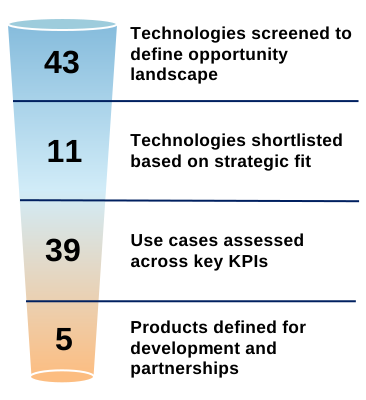
43 | Technologies and use cases screened across industries to define the full opportunity landscape and identify relevant sensing domains. |
11 | Technologies shortlisted through structured evaluation of maturity, feasibility and alignment with strategic priorities and capabilities. |
39 | Use cases assessed using detailed KPIs to quantify commercial potential, technical feasibility and competitive positioning across industries. |
5 | Priority products defined with clear development pathways, supported by vendor mapping and ecosystem insights for execution. |

Identified 5 priority product opportunities from 39 validated use cases across 12 industries, supported by detailed technology and vendor analysis.
The client is advancing product development and partnership discussions aligned to prioritised sensing solutions.
Enabled access to an estimated $18 billion market, with potential to unlock $100 million+ medium-term revenue streams.
Download our detailed case study to learn more about how CamIn and our hand-selected expert project team delivered these results for our client.

.svg)
Intelligent labelling and sensing solutions combine physical labels with embedded technologies that enable data capture, communication and decision-making. These include optical markers, wireless sensors, and printed electronics integrated into packaging or products.
They move labelling from a static identifier to a dynamic data interface. This allows companies to track products, monitor conditions, authenticate goods and engage directly with end users. As a result, packaging becomes part of the digital infrastructure rather than a cost centre.
For Fast-moving Consumer Goods and adjacent sectors, intelligent labelling directly addresses margin pressure, supply chain inefficiencies and rising regulatory demands. Traditional packaging offers limited differentiation and is increasingly commoditised.
Smart labelling enables new revenue streams through premium features such as authentication, traceability and condition monitoring. It also improves operational efficiency by reducing waste, enhancing inventory visibility and supporting automated processes.
In parallel, regulatory requirements around sustainability, product traceability and digital product passports are increasing. Intelligent labelling provides a scalable way to meet compliance while creating commercial upside, rather than treating it as a cost burden.
Intelligent labelling is evolving from niche pilots into scalable commercial applications across multiple sectors. The most attractive opportunities combine clear customer value with feasible deployment using existing infrastructure. The following sectors illustrate where near-term and longer-term value is being created.
In FMCG and retail, the immediate opportunity lies in improving supply chain visibility and reducing shrinkage. Quick wins include item-level tracking using low-cost optical or RFID solutions, enabling better inventory accuracy and reduced stock-outs. Retailers are also deploying anti-counterfeiting features for premium goods, particularly in cosmetics and beverages.
In the mid term, dynamic pricing and product interaction are gaining traction. Labels that integrate QR or NFC allow real-time updates on pricing, promotions and product information. This supports direct-to-consumer engagement and provides valuable first-party data, which is increasingly important as digital advertising becomes more constrained.
Long term, intelligent packaging will support circular economy models. Labels that track product lifecycle, usage and recycling pathways enable deposit schemes and material recovery at scale. This creates opportunities for new service-based revenue models, such as refill systems or packaging-as-a-service, particularly in high-volume consumer categories.
In pharmaceuticals, compliance and patient safety are the primary drivers. Quick wins include serialisation and authentication technologies that ensure product integrity and reduce counterfeit risks, particularly in high-value or temperature-sensitive drugs.
Mid-term opportunities focus on condition monitoring. Smart labels that track temperature, humidity or shock during transport can reduce spoilage and ensure regulatory compliance. This is particularly relevant for biologics and vaccines, where small deviations can result in significant losses.
Long term, integration with patient care is emerging. Intelligent labelling can support adherence monitoring, remote diagnostics and personalised treatment pathways. For example, packaging that communicates usage data to healthcare providers enables better patient outcomes while creating new service models for pharmaceutical companies.
In logistics, intelligent labelling is already delivering measurable efficiency gains. Quick wins include asset tracking and condition monitoring, which reduce loss, improve routing and optimise warehouse operations. These solutions often leverage existing infrastructure, making them commercially viable at scale.
Mid-term opportunities involve predictive logistics. By combining sensor data with analytics, companies can anticipate delays, optimise inventory positioning and reduce working capital requirements. This is particularly valuable in complex, multi-modal supply chains.
Long term, fully digitised supply chains will rely on intelligent labelling as a core data layer. Products will carry their own data, enabling autonomous decision-making across logistics networks. This creates opportunities for new platform-based business models and tighter integration between manufacturers, distributors and retailers.
In industrial sectors such as automotive, aerospace and chemicals, traceability and compliance are key drivers. Quick wins include part identification and lifecycle tracking, which support maintenance, quality control and regulatory reporting.
Mid-term, intelligent labelling enables predictive maintenance and asset optimisation. Sensors embedded in components can provide real-time data on performance and wear, reducing downtime and extending asset life.
Long term, these solutions support digital twins and advanced manufacturing ecosystems. By linking physical components to digital models, companies can optimise design, production and maintenance processes. This creates significant value through improved efficiency, reduced risk and enhanced product performance.
A range of technologies is enabling the shift towards intelligent labelling. Each offers distinct advantages and trade-offs, and their commercial viability depends on cost, scalability and integration with existing systems.
Optical technologies such as advanced barcodes, digital watermarks and computer vision are among the most scalable solutions. Their key strength is low cost and compatibility with existing infrastructure, making them attractive for high-volume applications.
They enable features such as product authentication, recycling sorting and consumer engagement through standard devices like smartphones. However, their functionality is limited compared to active sensing technologies, as they primarily rely on visual data.
Opportunities lie in combining optical markers with AI-driven analytics. This enhances detection accuracy and enables new use cases such as automated checkout and waste sorting. The main threat is commoditisation, as barriers to entry are relatively low and differentiation can be difficult to sustain.
Wireless technologies, including RFID, Bluetooth Low Energy and cellular IoT, provide real-time data transmission and tracking capabilities. Their strength lies in enabling continuous monitoring and integration with digital systems.
They are particularly effective for logistics, inventory management and high-value goods tracking. However, cost remains a barrier for item-level deployment in low-margin sectors, and infrastructure requirements can limit scalability.
Opportunities are emerging as costs decline and standards improve. Hybrid solutions that combine passive and active technologies can balance cost and functionality. The main risk is fragmentation, with multiple competing standards and ecosystems slowing adoption.
Printed electronics and nanoparticle-based sensors offer the potential to embed functionality directly into packaging at low cost. These technologies enable features such as temperature sensing, chemical detection and flexible circuitry.
Their strength is scalability, as they can be integrated into existing manufacturing processes. However, many solutions are still in development, with challenges around durability, accuracy and standardisation.
Opportunities lie in high-volume applications where marginal cost increases can be justified by reduced waste or improved quality. For example, temperature-sensitive food and pharmaceuticals can benefit significantly. The main threat is technological uncertainty, as commercial readiness varies widely across applications.
Artificial intelligence acts as an enabler across all intelligent labelling technologies. It allows companies to extract value from large volumes of data generated by sensors and labels.
Its strength lies in improving decision-making, from demand forecasting to quality control. AI can identify patterns, predict failures and optimise operations in ways that are not possible with traditional analytics.
However, its effectiveness depends on data quality and integration. Without reliable data inputs, AI systems deliver limited value. There are also challenges around data governance and security.
Opportunities are strongest when AI is integrated into end-to-end systems, linking labelling, logistics and customer engagement. This creates a competitive advantage through better insights and faster decision-making, but requires coordinated investment across multiple functions.


