Case Study
Digital wastewater optimisation product strategy
Unlocking wastewater efficiency with AI-driven monitoring, predictive maintenance, and resource optimisation


Unlocking wastewater efficiency with AI-driven monitoring, predictive maintenance, and resource optimisation
CamIn works with early adopters to identify new opportunities enabled by emerging technology.
of CamIn’s project team comprised of leading industry and technology experts


A wastewater client sought to develop new digital products and services to optimise municipal treatment operations, with CamIn identifying and validating 5 high-impact opportunities to support a $15 million investment.
Opportunity Compass
The client had a strong position in chemical treatment but sought to expand into digital offerings for municipal wastewater operators.
They aimed to develop new products and services that improve plant performance, reduce operational costs, and enhance resource efficiency.
To support a ~$15 million investment, they required a structured assessment of market needs, validation of use cases, and prioritisation of scalable opportunities to ensure successful commercialisation and measurable customer value.
%20.jpg)
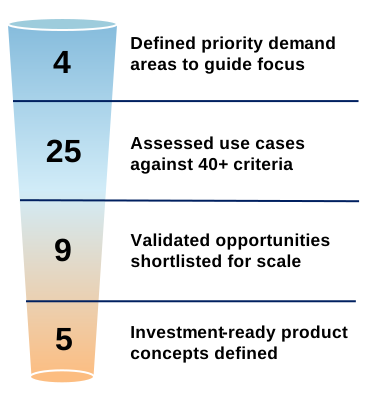
4 | Defined priority demand areas to focus the client’s digital strategy on high-impact customer needs and reduce uncertainty around where to invest. |
25 | Assessed digital use cases against over 40 technical and commercial criteria to eliminate low-value opportunities and enable evidence-based prioritisation. p> |
9 | Shortlisted validated opportunities with strong feasibility, customer relevance and scalability, reducing risk around adoption and implementation. |
5 | Developed investment-ready product concepts, providing clear direction and confidence for business case development and commercial decision-making. |

From 25 high-impact use cases (within 4 specific application areas), CamIn shortlisted 9 tech use cases that could provide quick-value to client customers.
CamIn confirmed the specific assets and client types (e.g. in terms of plant size) for which the use cases will provide most value.
CamIn confirmed the 5 most promising use cases around which the client can build new products and services, confirmed by interviews with current plant operators.
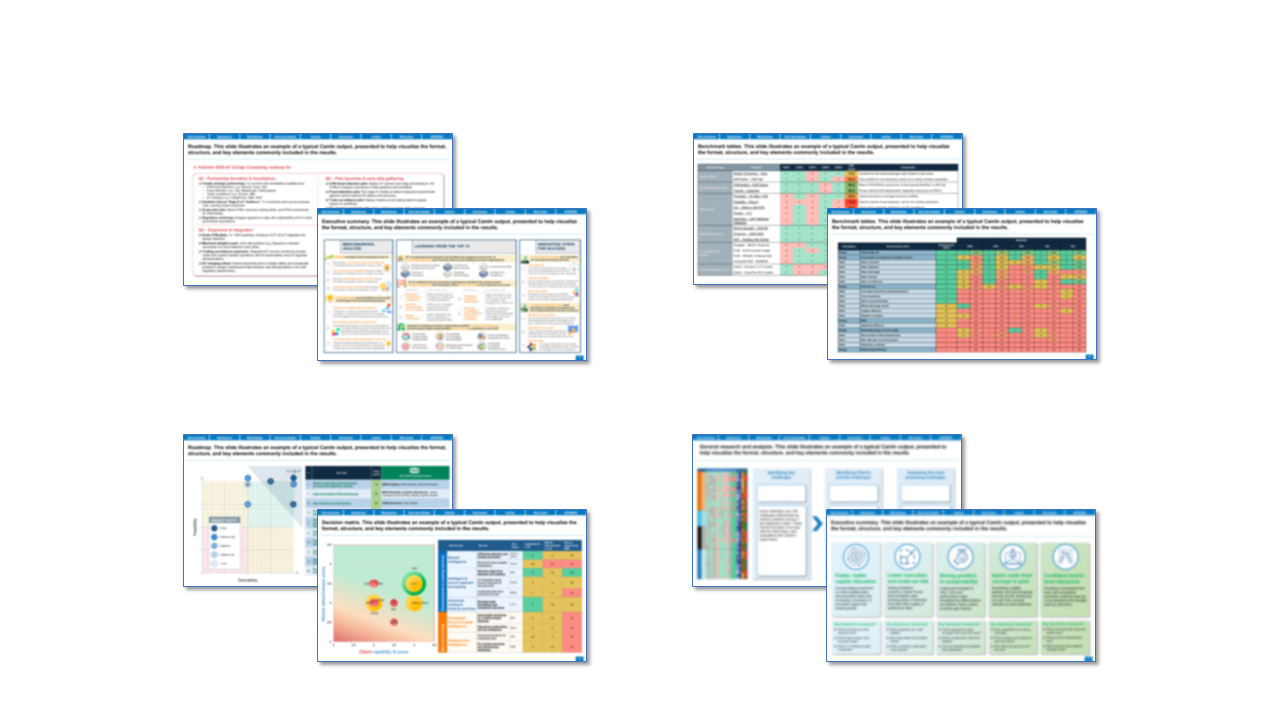
Download our detailed case study to learn more about how CamIn and our hand-selected expert project team delivered these results for our client.

.svg)
Digital solutions for municipal wastewater treatment refer to software, data, and connected technologies that optimise how treatment plants operate, maintain assets, and manage resources. These solutions combine sensors, analytics, and automation to improve process control, chemical dosing, energy use, and asset reliability.
They shift wastewater operations from manual and reactive processes towards data-driven and predictive management. For providers, this creates a new category of products and services that extend beyond chemicals and equipment into recurring, high-margin digital offerings.
Municipal wastewater operators face increasing pressure from tightening environmental regulations, ageing infrastructure, and rising operational costs. At the same time, many plants still rely on manual processes, limited data visibility, and reactive maintenance.
Digital solutions directly address these challenges by improving process efficiency, reducing chemical and energy consumption, and enabling predictive maintenance. This can translate into 10-25 percent reductions in operating costs, alongside improved compliance and asset lifespan.
For solution providers, this represents a structural shift in the value chain. Growth is moving from selling inputs such as chemicals towards delivering measurable outcomes such as performance optimisation, compliance assurance, and cost reduction. Companies that successfully transition to digital service models can capture recurring revenue, deepen customer relationships, and differentiate in an otherwise commoditised market.
Digital wastewater optimisation is moving from isolated pilot projects to structured product portfolios. The opportunity lies in developing scalable solutions that deliver measurable operational improvements for plant operators.
Many municipal plants still lack integrated, real-time visibility across processes. This creates inefficiencies in process control, delayed issue detection, and suboptimal resource use.
Quick wins include deploying sensor networks and dashboards that consolidate plant data into a single interface. These solutions typically deliver immediate improvements in operational transparency and can reduce manual monitoring effort by 20-40 percent.
Mid-term opportunities involve advanced analytics that identify process deviations and recommend corrective actions. These systems enable operators to optimise aeration, flow balancing, and sludge handling, reducing energy and chemical costs.
Long-term opportunities centre on fully integrated control systems where real-time data feeds automated decision-making. This allows plants to dynamically adjust operations based on incoming loads, weather patterns, and regulatory requirements. Providers that can package these capabilities into modular, easy-to-deploy products are well positioned to scale across fragmented municipal markets.
Unplanned downtime remains a significant cost driver for wastewater utilities, particularly given the critical nature of continuous treatment processes.
Quick-win opportunities include condition monitoring solutions that track key equipment parameters such as vibration, temperature, and flow. These systems can reduce emergency maintenance events and improve maintenance scheduling.
Mid-term opportunities involve predictive analytics that forecast equipment failures based on historical and real-time data. This enables utilities to shift from time-based to condition-based maintenance, reducing maintenance costs by an estimated 10-20 percent.
Long-term opportunities include integrated asset management platforms that combine maintenance, operations, and financial data. These platforms support lifecycle optimisation, capital planning, and performance benchmarking across multiple sites. For providers, the opportunity lies in embedding these solutions into service contracts, creating recurring revenue streams tied to performance outcomes.
Wastewater treatment is resource-intensive, with energy and chemicals representing a significant share of operating expenditure.
Quick wins focus on optimising chemical dosing through data-driven control systems. These solutions improve dosing accuracy and can reduce chemical usage by 10-30 percent, depending on plant variability.
Mid-term opportunities include energy optimisation platforms that adjust aeration and pumping based on real-time demand. Given that aeration can account for up to 60 percent of plant energy use, even small improvements deliver meaningful cost savings.
Long-term opportunities extend to integrated resource management systems that optimise water reuse, sludge valorisation, and nutrient recovery. These systems support circular economy models and can unlock new revenue streams, particularly where regulatory frameworks incentivise resource recovery.
Digital twins are emerging as a powerful tool for simulating and optimising wastewater treatment processes.
Quick-win applications include offline simulation tools that allow operators to test process changes before implementation. These reduce operational risk and improve decision confidence.
Mid-term opportunities involve real-time digital twins that continuously update based on live plant data. These models can predict process outcomes, enabling proactive adjustments to maintain compliance and optimise performance.
Long-term opportunities lie in network-level digital twins that model entire wastewater systems, including treatment plants and distribution networks. These enable strategic planning, capacity management, and resilience modelling. Providers that can integrate digital twin capabilities into broader service offerings will be able to position themselves as strategic partners rather than technology vendors.
A range of technologies underpin digital wastewater solutions, but their commercial value depends on how they are integrated into usable products and services.
Sensors are the foundation of digital wastewater solutions, providing real-time data on flow, turbidity, chemical concentration, and equipment performance.
Strengths include relatively low cost, scalability, and immediate impact on data availability. They enable quick deployment of monitoring solutions and form the basis for more advanced analytics.
Weaknesses include data quality variability, calibration requirements, and integration challenges with legacy systems. Poor data quality can undermine downstream analytics and reduce trust in digital solutions.
Opportunities lie in developing integrated sensor platforms with built-in calibration and data validation. Providers that can ensure reliable data capture gain a competitive advantage in delivering higher-value analytics services.
Threats include commoditisation of hardware and increasing competition from low-cost providers, which shifts value towards software and services.
Artificial intelligence and machine learning are increasingly used to optimise treatment processes and predict operational issues.
Strengths include the ability to identify complex patterns in large datasets and deliver actionable insights that improve efficiency and reduce costs.
Weaknesses include reliance on high-quality data and the need for domain-specific training. Black-box models can also reduce operator trust if outputs are not explainable.
Opportunities include developing explainable AI solutions tailored to wastewater operations, enabling operators to understand and act on recommendations. There is also potential to embed AI into service contracts where value is linked to performance improvements.
Threats include overpromising capabilities and underdelivering in real-world environments, which can slow adoption and create scepticism among operators.
Digital twins provide a virtual representation of wastewater processes, enabling simulation and optimisation.
Strengths include the ability to test scenarios without operational risk and to optimise complex, interconnected processes.
Weaknesses include high implementation complexity, data integration challenges, and the need for continuous model calibration.
Opportunities lie in simplifying deployment through modular digital twin solutions focused on specific processes, such as aeration or sludge management. This reduces upfront cost and accelerates adoption.
Threats include long implementation timelines and unclear return on investment, particularly for smaller utilities with limited budgets.
Edge computing and advanced connectivity enable real-time data processing and faster decision-making at the plant level.
Strengths include reduced latency, improved reliability, and the ability to operate in environments with limited connectivity.
Weaknesses include higher initial infrastructure requirements and the need for robust cybersecurity measures.
Opportunities include enabling real-time control systems and integrating edge computing into packaged digital solutions for remote or distributed assets. This is particularly relevant for smaller plants or decentralised systems.
Threats include fragmentation in standards and interoperability challenges, which can limit scalability across different plant environments.
Cloud-based platforms enable the integration of data across multiple plants and systems, supporting centralised monitoring and optimisation.
Strengths include scalability, flexibility, and the ability to deploy updates and new features rapidly.
Weaknesses include concerns around data security, regulatory compliance, and dependency on external providers.
Opportunities include developing platform-based business models where multiple digital services are delivered through a single interface. This supports cross-selling and long-term customer engagement.
Threats include increasing competition from large technology providers and the risk of disintermediation for companies that do not control the customer interface.


