Case Study
Sustainable plastics innovation strategy
Prioritising sustainable plastics technologies to enable confident, revenue-generating investment decisions.


Prioritising sustainable plastics technologies to enable confident, revenue-generating investment decisions.
CamIn works with early adopters to identify new opportunities enabled by emerging technology.
of CamIn’s project team comprised of leading industry and technology experts


A global chemicals manufacturer needed to prioritise sustainable feedstocks, recyclability, and material alternatives while filtering uncertainty across emerging technologies to enable confident, revenue-generating decisions.
Product & service innovation
The client faced uncertainty across key sustainability levers including bio-based feedstocks, recyclability of polymer formulations, and alternative materials to plastics.
While demand for sustainable products was rising, they lacked clarity on which technologies could deliver performance and scale.
They required a structured evaluation to prioritise credible options, reduce exposure to unproven solutions, and define a roadmap that balanced near-term improvements with long-term transformation.
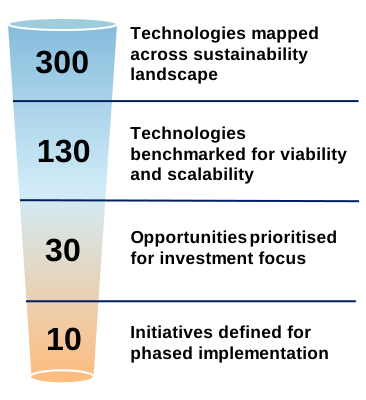
300 | Technologies identified through global scanning of feedstocks, recyclability, and alternative materials to establish a comprehensive innovation landscape. |
130 | Technologies assessed through benchmarking of technical feasibility, scalability, and commercial fit to eliminate non-viable or overhyped options. |
30 | Opportunities prioritised based on risk-adjusted impact and alignment with existing capabilities to focus investment decisions. |
10 | Initiatives defined through a phased roadmap enabling near-term revenue generation and long-term transformation pathways. |

Reduced uncertainty across ~300 technologies, prioritising credible opportunities across feedstocks, recyclability, and alternatives.
The client is progressing with selected pilots and strategic partnerships based on validated technology pathways.
Enabled approximately $5 million in new revenue while avoiding misallocated investment into non-viable solutions.
Download our detailed case study to learn more about how CamIn and our hand-selected expert project team delivered these results for our client.

.svg)
Sustainable plastics innovation refers to the redesign of materials, feedstocks, and processes to reduce environmental impact while maintaining performance and cost competitiveness. It spans bio-based inputs, improved recyclability, and substitution with alternative materials. A circular materials strategy extends this further by enabling reuse, recycling, and recovery across the product lifecycle, shifting value creation from linear production to closed-loop systems.
Sustainability in plastics is now directly linked to revenue growth, margin resilience, and licence to operate. Regulatory pressure on waste and emissions is tightening, while customers are increasingly specifying recycled or low-carbon materials. At the same time, many incumbent products face substitution risk from new materials and technologies.
For manufacturers, the challenge is not awareness but prioritisation. Hundreds of emerging technologies exist across feedstocks, recycling, and materials science, but only a fraction are commercially viable. Companies that can filter credible solutions early and align them with existing assets are better positioned to capture new markets, reduce stranded asset risk, and avoid misallocated capital.
Sustainable plastics innovation is moving from compliance-driven initiatives to a source of competitive advantage. Companies are increasingly using it to unlock new revenue streams, differentiate products, and secure long-term supply resilience. The opportunity spans multiple areas, each with distinct timelines and investment profiles.
Bio-based and waste-derived feedstocks are becoming viable substitutes for fossil inputs, but not all pathways are equally scalable.
Quick wins focus on drop-in bio-based feedstocks such as bio-polyols or bio-naphtha, which can be integrated into existing processes with limited capital expenditure. These offer immediate ESG improvements and premium pricing opportunities, particularly in consumer-facing applications.
Mid-term opportunities include chemically recycled feedstocks derived from mixed plastic waste. These can improve circularity but require partnerships across the value chain and reliable waste sourcing. Companies that secure feedstock supply early are gaining an advantage.
Long-term opportunities lie in advanced pathways such as CO2-based polymers or synthetic biology routes. While still emerging, these could reshape cost structures and reduce dependency on volatile fossil markets. Strategic positioning now can secure future licensing or partnership advantages.
Improving recyclability is shifting from a technical exercise to a commercial lever.
Quick wins include reformulating products to improve mechanical recyclability, such as simplifying polymer blends or removing additives that hinder processing. These changes can unlock access to recycled content markets without significant process redesign.
Mid-term opportunities involve design-for-recycling approaches, where products are engineered for disassembly and material recovery. This is particularly relevant in automotive, electronics, and packaging sectors, where regulatory pressure is increasing.
Long-term value lies in closed-loop systems where manufacturers retain ownership of materials through take-back schemes. This enables control over feedstock quality and reduces exposure to raw material volatility, but requires new business models and customer engagement strategies.
Alternative materials are emerging as both a threat and an opportunity for traditional plastics manufacturers.
Quick wins include blending existing polymers with biodegradable or bio-based components to meet regulatory thresholds without compromising performance. These hybrid solutions are gaining traction in packaging and consumer goods.
Mid-term opportunities involve adopting new material classes such as thermoplastic elastomers or advanced composites that offer similar functionality with improved sustainability profiles. These can open access to new applications and higher-margin segments.
Long-term disruption may come from entirely new material systems, including bio-fabricated materials or non-polymer substitutes. While still early-stage, these could displace certain plastics applications entirely, particularly where sustainability requirements outweigh performance constraints.
The complexity of sustainable plastics innovation means that few companies can capture value independently.
Quick wins include partnerships with technology providers to pilot proven solutions, reducing time to market and sharing development risk. These collaborations often focus on integrating existing technologies into current operations.
Mid-term opportunities involve co-development agreements with startups or research institutions, enabling access to emerging technologies before they reach scale. This approach allows companies to shape development pathways and secure preferential access.
Long-term strategies focus on ecosystem building, where companies participate in multi-stakeholder platforms across the value chain. This can unlock new revenue models, such as material-as-a-service, and improve resilience against supply and regulatory shocks.
The technology landscape for sustainable plastics is broad and fragmented, with solutions at varying levels of maturity. Understanding the strengths and limitations of each category is critical for prioritising investment and avoiding overexposure to unproven approaches.
Bio-based feedstocks are one of the most mature pathways for reducing carbon intensity.
Their key strength lies in compatibility with existing infrastructure, particularly for drop-in solutions. This enables faster adoption and lower capital requirements. However, scalability is constrained by feedstock availability and competition with other industries such as biofuels and food production.
Opportunities exist in securing long-term supply agreements and developing proprietary blends that balance performance and sustainability. The main risk is over-reliance on limited feedstock sources, which can lead to price volatility and supply disruptions.
Advanced recycling, including chemical recycling, is gaining attention as a solution for hard-to-recycle plastics.
These technologies can process mixed or contaminated waste streams, producing feedstocks comparable to virgin materials. This expands the addressable waste pool and supports circularity targets.
However, high capital costs and energy intensity remain key challenges. Many technologies are still scaling, and economic viability depends on policy support and stable waste supply.
The opportunity lies in early partnerships and pilot projects that position companies to scale as economics improve. The threat is investing too early in technologies that may not achieve cost competitiveness.
Biodegradable materials offer a solution for applications where recycling is not feasible, such as certain packaging or agricultural uses.
Their strength is regulatory alignment, particularly in regions with strict waste management requirements. However, performance limitations and higher costs restrict their use in more demanding applications.
Opportunities exist in niche markets where disposal challenges justify the premium, as well as in blending technologies that improve performance. The main risk is regulatory fragmentation, with differing standards across regions creating complexity for global manufacturers.
New material classes are emerging that challenge traditional plastics across multiple dimensions.
These include advanced composites, bio-fabricated materials, and novel polymers with enhanced recyclability or reduced environmental impact. Their strength lies in differentiation and the potential to open entirely new markets.
However, most are at early stages of development, with limited production capacity and uncertain cost structures.
Strategically, companies can benefit from selective exposure through partnerships or minority investments, balancing optionality with risk. The threat is being displaced in key applications if these materials reach scale faster than anticipated.
Digital tools are increasingly critical in enabling sustainable plastics innovation.
Technologies such as AI-driven material discovery, lifecycle analysis platforms, and digital twins allow companies to evaluate performance, cost, and environmental impact more efficiently.
Their strength lies in accelerating decision-making and reducing development timelines. However, their effectiveness depends on data quality and integration with existing systems.
Opportunities include using these tools to prioritise R&D investments and optimise product design. The risk is underutilisation, where companies invest in digital capabilities without embedding them into decision processes.


