Case Study
Rapid diagnostics due diligence
Testing scientific validity of rapid diagnostics before private equity investment decisions


Testing scientific validity of rapid diagnostics before private equity investment decisions
CamIn works with early adopters to identify new opportunities enabled by emerging technology.
of CamIn’s project team comprised of leading industry and technology experts


A private equity firm evaluated a rapid diagnostics acquisition to validate scientific claims, assess true technology maturity, and avoid investing in an unproven platform with overstated performance
Innovation Bridge
The client was pursuing an acquisition in rapid diagnostics to enter a new consumer healthcare segment, based on claims of breakthrough sensitivity and near-commercial readiness.
However, concerns emerged around the credibility of the underlying science. CamIn was engaged to rigorously test these claims, assess true technology maturity, and benchmark alternatives, with the objective of avoiding a potential €5 million misinvestment and ensuring only scientifically viable assets were pursued.
%20%20.jpg)
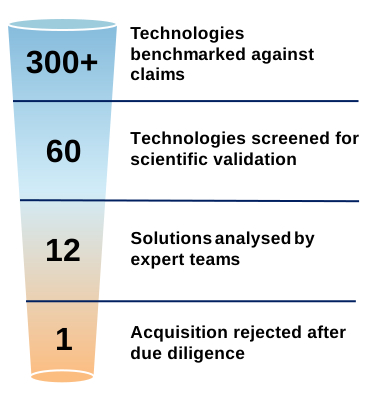
300+ | Technologies benchmarked to validate whether the target’s claims aligned with scientifically proven diagnostic approaches and established performance benchmarks across the global landscape. |
60 | Technologies screened to identify comparable sensing mechanisms and assess whether similar sensitivity claims had been independently validated or commercially demonstrated. |
12 | Solutions analysed through deep scientific review by expert teams, challenging assumptions and testing the feasibility of the underlying detection principles. |
1 | Acquisition opportunity rejected after identifying critical gaps between claimed performance and actual scientific maturity, confirming the technology was not investment-ready. |

Demonstrated that the target’s technology claims were materially overstated, with no validated scientific foundation.
The client is now refining its due diligence frameworks for frontier technologies and screening alternative assets.
Avoided an estimated 5€ million investment into a non-viable and high-risk technology platform.
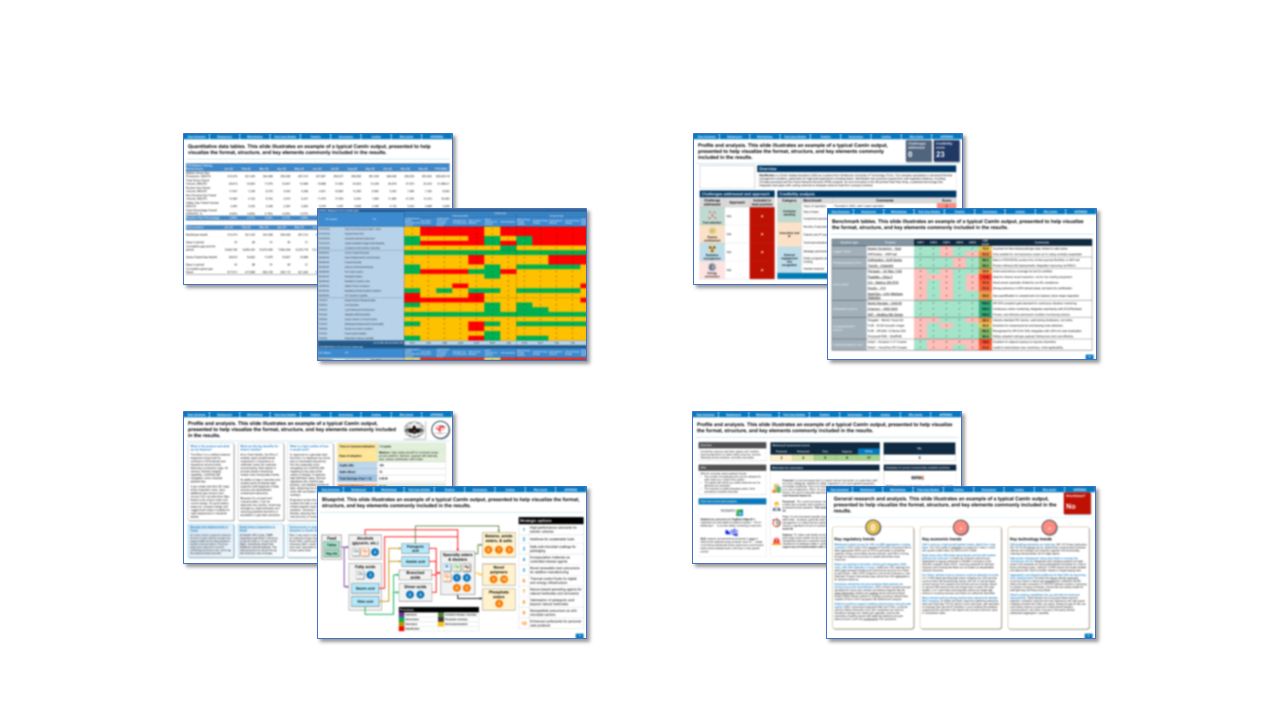
Download our detailed case study to learn more about how CamIn and our hand-selected expert project team delivered these results for our client.

.svg)
Rapid diagnostics technology due diligence is the structured evaluation of diagnostic platforms to verify scientific validity, technical maturity, and commercial viability before investment or acquisition. It goes beyond reviewing claims and focuses on testing whether underlying biological mechanisms, sensing technologies, and performance metrics are reproducible and scalable.
For investors and corporates entering healthcare, this involves benchmarking against alternative technologies, assessing technology readiness levels, and identifying gaps between claimed and achievable performance. It is particularly critical in early-stage innovations where marketing narratives often outpace scientific validation.
Healthcare diagnostics is characterised by rapid innovation, fragmented technologies, and high regulatory scrutiny. Many emerging platforms promise step-change improvements in sensitivity, speed, or cost, yet a significant proportion remain unproven outside controlled environments.
For investors and corporates, the risk lies in misjudging technology maturity. Overstated claims can lead to capital misallocation, delayed market entry, and reputational damage. This is particularly relevant for private equity and consumer health players entering unfamiliar scientific domains.
Rigorous due diligence enables decision-makers to distinguish between incremental improvements and genuinely disruptive technologies. It also clarifies development timelines, capital requirements, and regulatory hurdles. This allows organisations to prioritise investments with credible pathways to commercialisation, while avoiding assets that may require a decade of further development.
Rapid diagnostics is shifting from clinical settings into decentralised and consumer-facing applications. This transition is opening new commercial models and operational efficiencies, but requires careful selection of technologies that can scale reliably.
Point-of-care diagnostics is expanding into retail, home testing, and workplace health monitoring. Quick-win opportunities lie in adapting existing lateral flow and molecular platforms for consumer usability, enabling immediate revenue through direct-to-consumer channels.
Mid-term opportunities include integrating diagnostics with digital health ecosystems. Companies are embedding test results into apps that provide actionable insights, linking diagnostics to treatment pathways or subscription-based health services. This creates recurring revenue streams and deeper customer engagement.
Long-term potential sits in continuous or near-continuous monitoring. Advances in biosensing could enable passive detection of infections or biomarkers, shifting diagnostics from episodic testing to ongoing health tracking. However, scalability, cost, and regulatory approval remain significant barriers that require careful investment timing.
Rapid diagnostics is becoming a strategic asset in managing supply chains and mitigating operational risk. Quick-win applications include workplace screening and quality control in manufacturing environments, particularly in food and pharmaceuticals.
Mid-term opportunities involve integrating diagnostics into logistics networks. Real-time testing at distribution points can reduce contamination risks and improve compliance, particularly in cross-border supply chains.
Long-term, diagnostics could play a role in predictive resilience. Linking testing data with supply chain analytics may allow companies to anticipate disruptions from emerging health threats. This creates value not only through cost avoidance but also through improved reliability and customer trust.
Diagnostics is moving from a standalone product to a platform-based business model. Quick-win opportunities include bundling tests with services such as telemedicine or pharmacy fulfilment, increasing average revenue per user.
Mid-term, companies are exploring data-driven models. Aggregated diagnostic data can inform population health insights, product development, and targeted marketing. However, data governance and privacy regulations are critical considerations.
Long-term opportunities lie in personalised healthcare ecosystems. Diagnostics could become the entry point for tailored treatment pathways, subscription services, and preventative care models. This requires alignment across diagnostics, therapeutics, and digital platforms, which few organisations have yet fully achieved.
While the market is attractive, scaling diagnostics involves less visible challenges. Quick-win risks include overestimating the transferability of laboratory performance to real-world settings, leading to product failures post-launch.
Mid-term challenges relate to manufacturing and quality control. Many novel technologies face difficulties in achieving consistent performance at scale, which can erode margins and delay commercialisation.
Long-term risks include regulatory shifts and reimbursement uncertainty. Technologies that appear viable today may face stricter approval requirements or limited payer support. Organisations that anticipate these dynamics early can avoid stranded investments and prioritise more resilient opportunities.
The diagnostics landscape is shaped by multiple competing technologies, each with distinct trade-offs in sensitivity, speed, cost, and scalability. Understanding these differences is critical for investment decisions.
LAMP and RPA are isothermal amplification technologies that enable faster and simpler molecular testing compared to traditional PCR. Their key strength lies in operating without complex thermal cycling, making them suitable for decentralised and low-resource settings.
However, both technologies face challenges in specificity and robustness. False positives and sensitivity to environmental conditions can limit reliability outside controlled environments. This creates risk when scaling to consumer or mass-market applications.
Opportunities exist in integrating these technologies into portable devices and combining them with digital readouts. Organisations that can improve reliability while maintaining cost advantages are likely to capture early market share, particularly in emerging markets and decentralised healthcare systems.
CRISPR-based diagnostics offers high specificity by leveraging gene-editing mechanisms for detection. This enables highly targeted identification of pathogens and biomarkers, with potential for superior sensitivity compared to traditional methods.
The main limitation is maturity. Many CRISPR diagnostic platforms remain in early development stages, with limited large-scale validation and unclear manufacturing pathways. This creates a gap between scientific promise and commercial readiness.
Opportunities lie in niche applications where precision is critical, such as rare disease detection or advanced infectious disease diagnostics. Over time, improvements in scalability and cost could enable broader adoption, but near-term investment requires careful assessment of development timelines and regulatory pathways.
Electrochemical and optical biosensors are enabling faster and potentially continuous detection of biological signals. Their strength lies in real-time measurement and potential integration into wearable or portable devices.
Challenges include signal stability, calibration, and interference from complex biological samples. Many biosensors perform well in controlled environments but struggle with consistency in real-world use cases.
Opportunities are emerging in combining biosensors with AI-driven signal processing to improve accuracy. This could unlock applications in continuous monitoring and early detection, particularly in chronic disease management and preventative healthcare.
Lateral flow assays remain the most commercially established rapid diagnostic technology. Their strengths include low cost, ease of use, and established manufacturing processes. They are well suited for high-volume, low-margin applications.
However, their limitations in sensitivity and quantitative accuracy restrict their use in more advanced diagnostics. As expectations for performance increase, lateral flow alone may not meet future requirements.
Opportunities exist in hybrid approaches, where lateral flow is combined with molecular amplification or digital detection to enhance performance. This allows companies to leverage existing infrastructure while improving product differentiation and value.
A common risk is assuming that performance improvements demonstrated in laboratory conditions will translate directly to commercial products. In reality, many technologies face significant degradation in real-world settings.
Another overlooked factor is integration complexity. Combining sensing, sample preparation, and data interpretation into a single product often introduces unforeseen technical challenges.
The most critical risk is misjudging technology readiness. Platforms that appear close to market may still require years of development to achieve reliability, regulatory approval, and scalable manufacturing. Investors who rigorously test these assumptions can avoid costly missteps and focus on technologies with credible commercial pathways.


