Case Study
Geothermal lithium extraction partner selection
Identifying lithium extraction technology and partners for geothermal asset monetisation


Identifying lithium extraction technology and partners for geothermal asset monetisation
CamIn works with early adopters to identify new opportunities enabled by emerging technology.
of CamIn’s project team comprised of leading industry and technology experts


Energy and power client identified optimal lithium extraction technology and pilot partner to unlock new revenue from geothermal brines while de-risking a €10 million investment through structured technology, site, and vendor assessment.
Innovation Bridge
Driven by strong geothermal asset performance and increasing lithium demand, the client aimed to expand into lithium extraction as a new revenue stream. However, the complexity of technologies, site conditions, and market dynamics created uncertainty around investment decisions.
They required a structured evaluation of extraction technologies, vendor capabilities, and site-specific feasibility across multiple geothermal assets, alongside a forward-looking pricing model to support decision-making. The objective was to identify the most commercially viable technology and partner, reduce technical and financial risk, and support a multi-million-euro pilot investment.
.jpg)
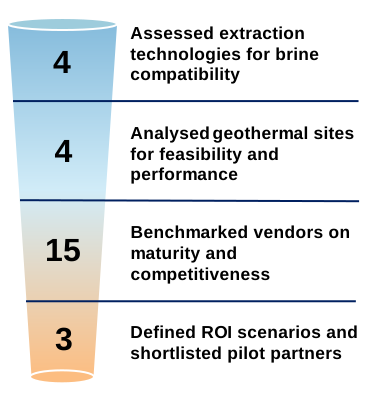
4 | Assessed four lithium extraction technologies against geothermal brine chemistry to determine technical feasibility and operational fit across client assets. |
4 | Analysed four geothermal sites in detail to evaluate brine composition, contaminant removal requirements, and expected process performance under real conditions. |
15 | Benchmarked global vendors based on technology maturity, competitiveness, and alignment with client requirements across relevant geographies and applications. |
3 | Developed ROI scenarios and shortlisted partners by integrating CAPEX, OPEX, and lithium price forecasts over a five-year commercial horizon. |

Identified optimal extraction technology and shortlisted 3 partners, enabling pilot launch and de-risking 10€ million investment.
Client is progressing pilot deployment and preparing scale-up strategy based on validated technology and partner.
Estimated multi-million-euro annual revenue potential supported by robust 5-year ROI scenarios.
Download our detailed case study to learn more about how CamIn and our hand-selected expert project team delivered these results for our client.

.svg)
Lithium extraction from geothermal brines refers to recovering lithium dissolved in hot subsurface fluids produced during geothermal energy generation. Instead of relying on traditional mining or evaporation ponds, operators extract lithium as a by-product of geothermal power operations. This approach integrates energy production with critical mineral recovery, creating a dual revenue model while reducing environmental impact and land use intensity compared to conventional lithium sources.
The energy transition is driving sustained demand for lithium, particularly for battery storage and electric mobility. Traditional supply chains face constraints linked to geography, permitting, water usage, and geopolitical concentration.
Geothermal brine extraction offers a structurally different supply source. It enables energy companies to monetise existing assets, improve project economics, and diversify revenue streams. It also supports regional supply security, particularly in Europe and North America, where local lithium production is strategically important.
For utilities and energy players, this creates a pathway to move beyond power generation into integrated energy and materials platforms. For policymakers, it offers a lower-impact alternative aligned with sustainability and resilience objectives.
The opportunity landscape is not uniform. Value creation depends on asset base, regulatory environment, and integration capabilities.
Operators with existing geothermal assets are best positioned to capture near-term value. Quick wins include piloting lithium extraction on high-lithium brine sites with minimal modification to existing infrastructure. These pilots typically focus on modular extraction units that can be retrofitted with limited downtime.
Mid-term opportunities involve optimising plant design to co-produce energy and lithium more efficiently. This includes integrating brine pre-treatment, heat recovery, and chemical processing into a unified system. Operators that redesign flow processes can improve both lithium yield and power generation efficiency.
Long-term value lies in repositioning geothermal assets as multi-output platforms. This includes producing lithium hydroxide or carbonate on-site and entering downstream battery supply chains. However, this requires capabilities in chemical processing, offtake agreements, and exposure to commodity price volatility.
Battery manufacturers and energy storage companies are increasingly exploring upstream integration to secure lithium supply. In the short term, partnerships with geothermal operators provide access to early-stage supply without full capital exposure.
Mid-term, joint ventures or offtake agreements can stabilise pricing and reduce reliance on traditional mining jurisdictions. These arrangements are particularly valuable in regions prioritising local sourcing for battery manufacturing.
Long-term opportunities include vertical integration into lithium refining and processing. However, the challenge lies in managing variability in brine chemistry and ensuring consistent quality at scale. Players that can standardise inputs across multiple geothermal sources will gain a structural advantage.
Chemical companies can capture value by supplying extraction technologies, reagents, and downstream processing expertise. Quick wins include licensing proprietary extraction materials such as sorbents or solvents tailored to geothermal brines.
Mid-term, these players can move into integrated processing solutions, offering end-to-end lithium recovery systems. This includes brine conditioning, extraction, purification, and conversion into battery-grade materials.
Long-term, there is an opportunity to establish regional lithium processing hubs linked to multiple geothermal sites. This model reduces unit costs and improves scalability. However, success depends on securing consistent feedstock and managing complex logistics between dispersed assets.
Infrastructure funds are beginning to view geothermal lithium projects as hybrid assets combining energy generation and mineral extraction. In the short term, investment is focused on pilot projects and early commercial deployments with proven technologies.
Mid-term, there is scope to finance scaled facilities once technical risks are reduced. These projects offer diversified revenue streams, but require careful structuring around commodity price exposure and operational complexity.
Long-term opportunities include portfolio strategies that aggregate multiple geothermal lithium assets across regions. This enables risk diversification and creates optionality in response to lithium price cycles. However, investors must develop a deeper understanding of both energy and mining economics, which are traditionally managed separately.
The technology landscape is evolving rapidly, with several competing approaches offering different trade-offs between efficiency, cost, and scalability.
Ion exchange systems use specialised materials to selectively capture lithium ions from brine. Their key strength is high selectivity, which allows efficient separation even in complex brine compositions. This makes them suitable for geothermal fluids with high levels of competing ions.
However, performance depends heavily on material stability and regeneration cycles. Degradation over time can increase operating costs and reduce recovery rates. Scaling these systems also requires consistent brine chemistry, which is not always guaranteed across sites.
Opportunities lie in improving sorbent materials and integrating adsorption units into modular systems for rapid deployment. The main threat is competition from alternative technologies that offer higher throughput or lower operational complexity.
Solvent extraction uses chemical solvents to separate lithium from brine through selective binding. These systems can achieve high recovery rates and are relatively well understood from other industrial applications.
The main limitation is sensitivity to impurities, which can reduce efficiency and increase the need for pre-treatment. This adds complexity and cost, particularly for geothermal brines with variable compositions.
The opportunity lies in developing more robust solvents and hybrid systems that combine extraction with pre-treatment. The threat is that operational complexity may limit adoption in smaller or less standardised geothermal operations.
Hybrid systems combine multiple techniques such as adsorption, membranes, and chemical precipitation to optimise recovery. These approaches aim to balance selectivity, speed, and cost.
Their strength is flexibility. They can be tailored to specific brine chemistries and integrated into existing geothermal operations. This makes them attractive for pilot projects and early deployments.
However, complexity is a key challenge. Integrating multiple processes increases capital requirements and operational risk. There is also limited long-term performance data at scale.
Opportunities exist in standardising modular hybrid systems that can be deployed across different sites. The main threat is execution risk during scale-up, particularly in maintaining consistent performance.
Membrane technologies use selective filtration to separate lithium ions based on size or charge. They offer the potential for continuous processing and lower chemical usage.
Their key advantage is operational simplicity compared to chemical-intensive processes. However, membranes can suffer from fouling and reduced efficiency over time, particularly in geothermal brines with high impurity levels.
Opportunities lie in developing more durable membranes and combining them with pre-treatment systems to improve reliability. The threat is that current performance limitations may restrict their use to niche applications rather than large-scale deployment.


