Case Study
De-risking IoT technology investment decisions
Validating IoT applications to de-risk investment and strengthen acquisition decisions


Validating IoT applications to de-risk investment and strengthen acquisition decisions
CamIn works with early adopters to identify new opportunities enabled by emerging technology.
of CamIn’s project team comprised of leading industry and technology experts


Independent technology due diligence to validate an IoT innovation, challenge flawed application assumptions, and redefine the investment thesis towards defensible, high-value opportunities
Product & service innovation
The client required independent technology due diligence on a novel multi-signal reception module as part of an acquisition process.
While the target company had defined initial application areas, there was uncertainty around their long-term viability and competitive positioning.
The objective was to assess technological differentiation, identify stronger alternative IoT use cases, and quantify commercial potential.
This enabled the client to avoid a high-risk investment, challenge flawed assumptions, and redirect capital towards more defensible, high-value opportunities with clearer long-term upside.
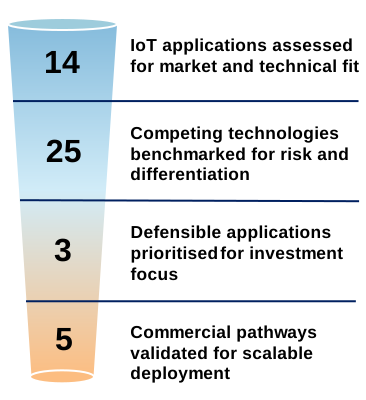
14 | IoT applications assessed through detailed evaluation of technical fit, scalability, and alignment with evolving market demand. |
25+ | Competing technologies benchmarked against performance, cost, and roadmap to identify disruption risks and validate differentiation. |
3 | Defensible applications prioritised based on measurable advantage, commercial viability, and long-term competitive positioning. |
5+ | Commercial pathways defined through partner identification and validated routes to scalable licensing and market entry. |

Identified that initial target applications lacked long-term defensibility due to emerging competing technologies.
Reframed the opportunity towards three higher-value IoT applications with stronger differentiation and scalability.
De-risked a multi-million dollar acquisition by strengthening the investment thesis and avoiding misallocation of capital.
Download our detailed case study to learn more about how CamIn and our hand-selected expert project team delivered these results for our client.


.svg)
Multi-signal reception and processing modules are advanced IoT components designed to capture, filter, and interpret multiple signals across different frequencies and protocols simultaneously. Unlike traditional single-channel systems, these modules operate reliably in complex environments where signal interference, congestion, or overlap would otherwise degrade performance.
They are typically embedded within edge devices or gateways and enable higher data fidelity, improved connectivity resilience, and more efficient integration of diverse sensors. Their value lies in enabling IoT systems to function effectively in environments where conventional communication architectures struggle.
As IoT deployments scale, devices increasingly operate in environments with high signal density, overlapping protocols, and unpredictable interference. Traditional communication modules often fail to maintain reliability under these conditions.
Multi-signal modules address this limitation by enabling consistent data capture and transmission across complex environments. This improves system uptime, data accuracy, and operational efficiency.
For strategy and innovation leaders, the importance lies in unlocking use cases that were previously not commercially viable due to technical constraints. It also reduces the risk of system failure in mission-critical applications, which directly impacts cost, safety, and scalability.
The commercial relevance of these modules is increasing as IoT systems move into more demanding, data-intensive environments.
Industrial environments are characterised by dense machinery, electromagnetic interference, and fragmented connectivity. Quick-win opportunities include upgrading existing sensor networks to improve reliability in data collection. Mid-term, multi-signal modules can enhance predictive maintenance by ensuring continuous, high-quality data streams. Long-term, they enable fully autonomous production environments where consistent signal interpretation is critical for safe and efficient operation. A key insight is that value is highest not in new installations, but in retrofitting existing assets where failure rates are currently highest.
Urban environments present complex signal ecosystems with overlapping wireless technologies. Near-term opportunities lie in improving the reliability of existing smart infrastructure such as traffic systems and utilities monitoring. Mid-term, cities can consolidate multiple sensing systems into unified platforms that reduce redundancy and cost. Long-term, multi-signal capability becomes essential for integrated urban control systems that rely on real-time, multi-source data. A less obvious opportunity is in reducing infrastructure maintenance costs by improving data reliability rather than increasing sensor density.
Tracking assets in warehouses, ports, and transit hubs often suffers from signal interference and blind spots. Quick wins include improving location accuracy and reducing data loss in high-density environments. Mid-term opportunities involve integrating multiple tracking technologies into a single system, improving operational visibility. Long-term, the ability to reliably capture multi-source data enables predictive logistics and autonomous inventory management. The strategic value lies in reducing operational inefficiencies rather than simply improving tracking precision.
Security systems require consistent data capture across multiple inputs, including video, motion, and environmental sensors. Immediate opportunities exist in upgrading systems to handle higher data complexity without loss of signal integrity. Mid-term, integration with AI-driven analytics increases the value of captured data. Long-term, these modules support autonomous security systems that rely on uninterrupted, high-quality inputs. A critical but underappreciated factor is that improved signal reliability directly reduces false positives and operational overhead.
The evolution of multi-signal reception modules is driven by a combination of hardware innovation and system-level integration.
These systems use sophisticated algorithms to separate, filter, and interpret overlapping signals. Their strength lies in enabling reliable performance in congested environments. However, they require significant computational resources and careful calibration. The opportunity is strongest in high-value applications where data integrity is critical. The threat is that cost and complexity may limit adoption in lower-margin use cases.
Combining multi-signal reception with edge computing allows data to be processed locally, reducing latency and bandwidth requirements. This is particularly valuable in time-sensitive applications. The limitation is increased system complexity and integration effort. The opportunity lies in creating self-contained, high-performance IoT nodes. The risk is fragmentation across hardware and software ecosystems.
Modern IoT systems increasingly combine multiple communication protocols within a single device. Multi-signal modules enable seamless switching and integration across these protocols. Their strength is flexibility and resilience. However, managing interoperability can be challenging. The opportunity lies in building systems that are less dependent on any single network. The threat is increased design complexity and potential standardisation challenges.
By combining inputs from multiple sensors, these systems improve accuracy and reliability. The strength is enhanced decision-making capability. The limitation is increased processing requirements and system cost. Opportunities exist in applications where precision and reliability justify the investment. The risk is over-engineering solutions for use cases that do not require such sophistication.


