Case Study
Benchmarking sustainable materials acquisition targets
Validated acquisition targets and identified new high-fit sustainable technology opportunities.


Validated acquisition targets and identified new high-fit sustainable technology opportunities.
CamIn works with early adopters to identify new opportunities enabled by emerging technology.
of CamIn’s project team comprised of leading industry and technology experts


Our industrial materials client sought to validate and prioritise acquisition targets aligned to sustainability-led growth areas, identifying 45 high-priority opportunities and strengthening a $5 million investment pipeline.
Horizon & Portfolio Scanner
The client faced strong innovation pipeline activity but lacked a structured system to monitor and assess acquisition targets, resulting in significant inefficiencies and resource drain.
They aimed to validate their current pipeline and identify new high-potential opportunities aligned to sustainability and advanced materials growth areas.
The objective was to de-risk a $5 million investment fund, reduce wasted effort, and improve decision quality by focusing only on strategically relevant and credible targets.
%20.jpg)
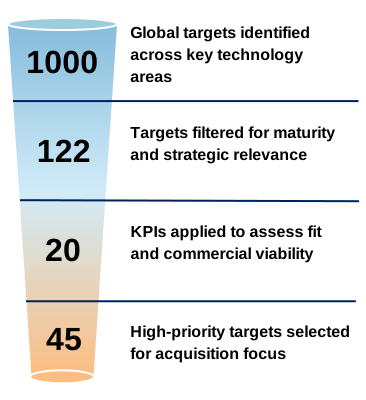
1000 | Potential acquisition targets were identified globally across defined application areas and geographies aligned to the client’s sustainability and advanced materials growth priori |
122 | Targets were shortlisted using filters on technology maturity, strategic relevance, and commercial alignment to focus evaluation on credible and scalable opportunities. |
20 | KPIs were applied to assess each target’s strategic fit, value chain position, and commercial viability through expert validation and structured benchmarking. |
45 | High-priority targets were selected, including overlooked opportunities, forming a refined and credible acquisition pipeline aligned to the client’s investment strategy. |

45 high-priority acquisition targets identified from 1,000+ screened, alongside validation of 20 existing targets.
Client is now refining acquisition strategy and progressing priority targets into due diligence and partnership discussions.
Estimated $5 million investment de-risked, with improved allocation efficiency and reduced internal evaluation effort.
Download our detailed case study to learn more about how CamIn and our hand-selected expert project team delivered these results for our client.

.svg)
Sustainable materials and circular economy technologies refer to a broad set of innovations that reduce emissions, improve resource efficiency, and enable value recovery from waste across industrial value chains. These include carbon capture systems, advanced ceramics, low-carbon construction materials, and recycling and waste valorisation technologies. Together, they shift production from linear, resource-intensive models towards more resilient, lower-cost, and regulation-ready operating structures.
Industrial materials companies sit at the centre of emissions-intensive value chains, where energy costs, regulatory exposure, and raw material volatility directly impact margins. As decarbonisation requirements tighten and customers demand lower-impact products, these technologies are becoming critical to maintaining competitiveness.
Beyond compliance, they offer structural advantages. Carbon capture can extend the life of existing assets. Recycling and waste valorisation reduce dependence on volatile feedstocks. Advanced materials improve performance and durability, enabling premium pricing. Sustainable construction solutions are increasingly specified by regulators and large buyers, influencing demand patterns.
Companies that fail to adapt risk margin erosion, stranded assets, and loss of market access. Those that act early can secure cost advantages, shape supply chains, and capture emerging growth segments linked to energy transition and circularity.
Sustainable materials innovation is no longer limited to long-term R&D. A clear set of near-term and scalable opportunities is emerging across multiple segments, with varying timelines for commercial impact.
Carbon capture is becoming a strategic lever in hard-to-abate sectors where electrification alone cannot eliminate emissions. Quick wins are emerging in retrofit solutions for existing plants, particularly modular capture units that can be deployed without major process redesign. These allow companies to reduce emissions intensity while maintaining production continuity.
Mid-term opportunities lie in integrating capture with utilisation pathways, such as converting CO2 into chemicals, fuels, or construction inputs. While still dependent on economics and policy support, these pathways can create new revenue streams and reduce exposure to carbon pricing mechanisms.
Long-term value will depend on access to transport and storage infrastructure, which remains uneven across regions. Companies that secure early partnerships in CO2 logistics and storage networks will be better positioned to scale and monetise captured carbon, while those without access risk stranded investments.
Advanced ceramics are gaining traction in applications requiring high durability, thermal resistance, and performance under extreme conditions. In the near term, opportunities are centred on replacing traditional materials in high-wear environments, reducing maintenance costs and downtime for industrial operators.
Mid-term growth is expected in electrification-related applications, including components for batteries, power electronics, and semiconductor manufacturing. These segments are driven by structural demand shifts, offering stable growth potential and higher margins compared to commoditised materials.
Long-term opportunities lie in highly specialised applications such as aerospace and next-generation energy systems. However, scaling production while maintaining quality and cost competitiveness remains a challenge. Companies that invest in advanced manufacturing techniques and secure supply of high-purity inputs will gain an advantage.
Construction materials are under increasing pressure to reduce embodied carbon, driven by regulation and procurement standards. In the near term, low-clinker cements and supplementary cementitious materials offer practical pathways to reduce emissions without significant changes to existing infrastructure.
Mid-term opportunities include digital optimisation of material formulations and production processes, improving both cost efficiency and emissions performance. These solutions often deliver dual benefits, making them attractive for rapid adoption.
Long-term growth will depend on the development and scaling of alternative binders and carbon-negative materials. While technically promising, these solutions face barriers related to standardisation, certification, and conservative industry adoption patterns. Companies that engage early with regulators and large buyers can influence standards and accelerate market entry.
Recycling and waste valorisation technologies are shifting from compliance-driven activities to core profit centres. In the near term, improvements in sorting and processing efficiency, particularly through automation and AI, are increasing recovery rates and reducing operational costs.
Mid-term opportunities focus on converting waste into secondary feedstocks for chemicals and materials production. This reduces reliance on virgin inputs and creates more stable cost structures, particularly in volatile commodity markets.
Long-term value lies in fully integrated circular systems where waste streams are systematically converted into high-value products. However, this requires coordination across value chains and significant capital investment. Companies that secure access to consistent waste streams and build partnerships across the ecosystem will be better positioned to capture value.
A range of enabling technologies is driving progress across these areas. Each comes with distinct strengths, limitations, and strategic implications for industrial players.
Carbon capture technologies include solvent-based systems, solid sorbents, membranes, and process-integrated approaches such as oxyfuel combustion. Their primary strength lies in their ability to reduce emissions from existing assets, preserving capital investments and extending asset life.
However, costs remain a key constraint, particularly energy requirements for capture and compression. The economic case is highly dependent on carbon pricing and policy incentives, creating regional variability in adoption.
Opportunities are strongest where capture can be combined with utilisation or where infrastructure for transport and storage is already in place. The main threat is technological lock-in, where companies commit to suboptimal solutions that may be overtaken by more efficient alternatives.
Technologies such as precision sintering, additive manufacturing, and advanced coatings are enabling the production of high-performance materials with improved properties and reduced waste. These technologies support the shift towards higher-value, differentiated products.
Their strength lies in flexibility and performance enhancement, allowing companies to target niche applications with strong margins. However, they often require significant capital investment and specialised expertise, limiting rapid scale-up.
Opportunities are concentrated in sectors with high performance requirements, such as electronics and energy systems. The risk lies in fragmentation of standards and the need to continuously innovate to maintain competitive advantage.
Emerging technologies include low-carbon cement formulations, digital process optimisation tools, and carbon curing methods. These solutions aim to reduce emissions without disrupting established construction practices.
Their key advantage is compatibility with existing infrastructure, enabling faster adoption. However, performance consistency and regulatory approval remain barriers, particularly for novel materials.
Opportunities are driven by regulatory pressure and large-scale infrastructure investment, creating demand for lower-carbon alternatives. The main threat is slow industry adoption, which can delay return on investment despite strong underlying demand signals.
Technologies such as AI-enabled sorting, chemical recycling, and waste-to-feedstock conversion are transforming how waste is managed and monetised. These technologies enable higher recovery rates and the production of higher-quality secondary materials.
Strengths include improved efficiency and the ability to handle complex waste streams that were previously uneconomical to process. However, economic viability is sensitive to input quality and market prices for recycled outputs.
Opportunities lie in integrating these technologies into broader production systems, reducing dependence on virgin materials. The main risk is regulatory uncertainty and variability in waste supply, which can impact utilisation rates and profitability.


