Case Study
CO₂-to-value pathways for fuels and polymers
Identifying viable CO₂ utilisation technologies to unlock scalable low-carbon product growth

.png)


Identifying viable CO₂ utilisation technologies to unlock scalable low-carbon product growth
CamIn works with early adopters to identify new opportunities enabled by emerging technology.
of CamIn’s project team comprised of leading industry and technology experts


CamIn supported an oil and gas client in identifying and prioritising carbon utilisation technologies and partners to unlock new revenue streams while de-risking a $25 million investment through pilot-ready opportunities
Product & service innovation
The client aimed to diversify beyond traditional refining by converting captured CO₂ into fuels and polymers, driven by strong performance and strategic decarbonisation goals.
They sought to identify viable technologies and partners to enable new product development aligned with circular economy trends.
The objective was to de-risk a $25 million investment by validating technology pathways, confirming business cases, and enabling pilot deployments with clear revenue potential.
.jpg)
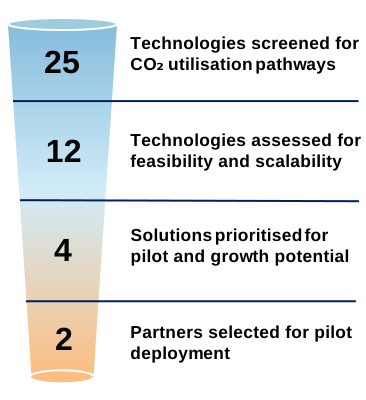
25 | Technologies were screened across carbon utilisation pathways to identify viable fuel and polymer production options aligned with strategic and technical requirements. |
12 | Technologies were prioritised through detailed assessment of feasibility, scalability, and alignment with client capabilities and downstream integration potential. |
4 | Solutions were selected based on commercial viability, technical maturity, and ability to support near-term pilots and long-term product portfolio diversification. |
2 | Partners were identified through benchmarking over 40 organisations, selecting those with strongest IP, scalability, and fit for pilot deployment and collaboration. |

Narrowed 25 technologies to 4 high-potential solutions and identified 2 partners for pilot deployment.
Client is progressing pilots and validating commercial pathways for new low-carbon product lines.
De-risked a $25 million investment with clear route to multi-million revenue upside.
Download our detailed case study to learn more about how CamIn and our hand-selected expert project team delivered these results for our client.

.svg)
Carbon capture and utilisation for fuels and polymers refers to technologies that convert captured CO₂ into valuable products such as synthetic fuels, chemicals, and polymer feedstocks. Instead of treating CO₂ as waste, it is used as a carbon input for industrial processes. This enables companies to reduce emissions while creating new revenue streams from existing operations and infrastructure.
Carbon utilisation provides a commercially relevant pathway to decarbonisation without requiring a full shift away from hydrocarbons. It allows companies to leverage existing assets, capabilities, and customer relationships while responding to regulatory pressure and investor expectations.
For downstream players, it offers an opportunity to move up the value chain into differentiated, lower-carbon products. It also reduces exposure to carbon pricing and future compliance costs. Importantly, it creates optionality. Companies can pursue near-term revenue opportunities while positioning for longer-term structural shifts in demand for sustainable fuels and materials.
The opportunity landscape in carbon utilisation is expanding rapidly, but remains uneven in maturity and commercial readiness. Executives need to balance quick wins with longer-term positioning.
Synthetic fuels derived from CO₂ and green hydrogen offer a direct pathway to decarbonise sectors such as aviation, shipping, and heavy transport where electrification is limited.
In the near term, opportunities exist in blending low volumes of e-fuels into existing fuel supply chains, particularly where mandates or incentives support premium pricing. These projects can leverage existing refining and distribution infrastructure, reducing capital intensity.
Mid-term, as hydrogen costs decline, fully synthetic fuels become more viable at scale. Strategic positioning around feedstock sourcing, long-term offtake agreements, and integration with renewable energy assets becomes critical.
Long-term, companies that secure early access to low-cost hydrogen and CO₂ sources can build defensible positions in global fuel markets. However, margins remain sensitive to input costs and policy stability, making careful partner and location selection essential.
Using CO₂ as a feedstock for polymers and chemicals allows companies to enter higher-margin specialty markets while reducing lifecycle emissions.
Quick-win opportunities exist in niche applications such as polycarbonates, polyols, and intermediates where partial CO₂ substitution is already technically feasible. These can command premium pricing in sustainability-driven segments such as packaging and consumer goods.
In the mid-term, improved catalysts and process efficiencies are expected to increase CO₂ utilisation rates, making products more cost-competitive. Integration into existing petrochemical value chains can further improve economics.
Long-term, CO₂-derived polymers could enable entirely new material classes with differentiated properties. However, scalability and consistent feedstock supply remain key constraints, requiring close alignment between capture, processing, and end-use markets.
Carbon utilisation enables a shift from linear to circular carbon flows, particularly in industrial clusters where CO₂ emissions are concentrated.
Near-term opportunities include capturing CO₂ from point sources and converting it into intermediate chemicals within the same site. This reduces transport costs and enables faster pilot deployment.
Mid-term, industrial hubs can develop shared infrastructure for CO₂ capture, storage, and utilisation, lowering barriers to entry for multiple players. Strategic collaboration becomes a key differentiator.
Long-term, integrated carbon ecosystems could emerge where CO₂ is continuously recycled across industries. Companies that establish early positions in such ecosystems can secure long-term feedstock access and create new platform business models.
The most credible early opportunities lie at the intersection of technical feasibility and clear market demand.
In the short term, technologies with high technology readiness levels and existing customer demand offer the best risk-return profile. These include incremental improvements to existing processes rather than entirely new value chains.
Mid-term, selective investments in emerging technologies can provide strategic optionality, particularly where intellectual property or first-mover advantage is achievable.
Long-term, transformational technologies require patient capital and partnerships but can redefine competitive positioning. A balanced portfolio approach is essential to manage risk while capturing upside.
The technology landscape is diverse, with varying levels of maturity, cost competitiveness, and scalability. Understanding trade-offs is critical for effective investment decisions.
Catalytic conversion technologies use chemical catalysts to transform CO₂ into fuels and chemicals such as methanol or olefins.
Their main strength lies in compatibility with existing industrial processes, enabling relatively straightforward integration into current assets. Many pathways are already at pilot or early commercial scale, offering near-term deployment potential.
However, performance depends heavily on catalyst efficiency and operating conditions. Energy intensity remains a key challenge, particularly when relying on green hydrogen.
Opportunities exist in improving catalyst selectivity and durability, which can significantly enhance economics. Companies investing early in proprietary catalyst technologies can secure strong competitive advantages. The main risk is exposure to volatile input costs and uncertain policy support.
Electrochemical technologies convert CO₂ into chemicals using electricity, often powered by renewable energy.
Their key advantage is flexibility. Systems can be modular and operate at smaller scales, making them suitable for decentralised deployment near emission sources. This reduces transport and infrastructure requirements.
However, most electrochemical pathways remain at low to mid technology readiness levels. Efficiency, stability, and product purity are ongoing challenges.
The opportunity lies in coupling these systems with renewable energy assets to create integrated low-carbon production platforms. As renewable energy costs decline, these technologies could become more competitive. The main threat is slow scale-up and uncertain commercial timelines.
Biological processes use microorganisms or enzymes to convert CO₂ into fuels and chemicals.
These approaches operate under milder conditions and can achieve high selectivity, making them attractive for specific applications. They are particularly relevant for producing specialty chemicals and niche products.
However, scalability remains a significant constraint. Biological systems can be sensitive to operating conditions and may require complex downstream processing.
Opportunities exist in hybrid systems that combine biological and chemical processes, improving overall efficiency. Companies exploring this space should focus on applications where product value offsets higher production complexity. The main risk is long development timelines and uncertain scalability.
Advanced polymerisation technologies incorporate CO₂ directly into polymer structures, creating new materials with reduced carbon footprints.
These technologies offer strong differentiation potential, particularly in applications where sustainability credentials are valued by end customers. Some processes are already commercially available, enabling near-term market entry.
However, CO₂ incorporation rates are often limited, and material performance must meet strict industry standards. Scaling production while maintaining quality is a key challenge.
Opportunities lie in developing polymers with unique properties that cannot be easily replicated by conventional materials. This creates defensible market positions. The main threat is competition from established petrochemical processes with lower costs and proven reliability.
Many carbon utilisation pathways rely on hydrogen as a key input, particularly for fuel production.
Access to low-cost, low-carbon hydrogen is therefore a critical success factor. Companies that secure early access to renewable hydrogen supply can significantly improve project economics.
However, hydrogen availability remains constrained, and infrastructure is still developing. This creates uncertainty around timing and scalability of many CO₂ utilisation projects.
Opportunities exist in co-locating carbon utilisation facilities with hydrogen production or renewable energy assets. Strategic partnerships across the value chain will be essential. The main risk is over-reliance on future cost reductions that may not materialise at the expected pace.


